
What Are Somatic Therapies? A Clear Guide for 2026

Somatic therapy is defined as a body-centered form of psychotherapy that uses physical sensations, movement, and breath to process trauma and emotional distress stored in the nervous system. Unlike traditional talk therapy, which works primarily through language and thought, somatic therapy works directly with the body’s physical responses to heal psychological wounds. Research shows that somatic interventions for PTSD can produce a 44–90% reduction in symptoms across 3 to 20 sessions. That range reflects how powerfully the body holds onto stress and how effectively body-centered work can release it. If you’ve tried talk therapy and still feel stuck, somatic approaches may offer a path forward.
What are somatic therapies and how do they differ from talk therapy?
Somatic therapy, also called body-oriented therapy, is a licensed form of psychotherapy that focuses on the connection between physical sensations and emotional health. The word “somatic” comes from the Greek word soma, meaning body. The core idea is that trauma, anxiety, and chronic stress are not only stored in the mind but also encoded in the body’s muscles, posture, and nervous system.
Traditional talk therapies like Cognitive Behavioral Therapy (CBT) work from the top down. They engage the prefrontal cortex, the thinking part of the brain, to reframe beliefs and change behavior. Somatic therapy takes the opposite route. It works bottom-up, activating subcortical circuits in the brain and nervous system directly, bypassing the need to verbalize every experience.
This distinction matters most for people who have experienced trauma. Trauma often lives below the level of conscious thought. A person may understand intellectually that a past event is over, yet still feel their heart race or muscles tense in response to reminders. Somatic therapy targets exactly that gap between knowing and feeling.
How does somatic therapy work to heal mind and body?
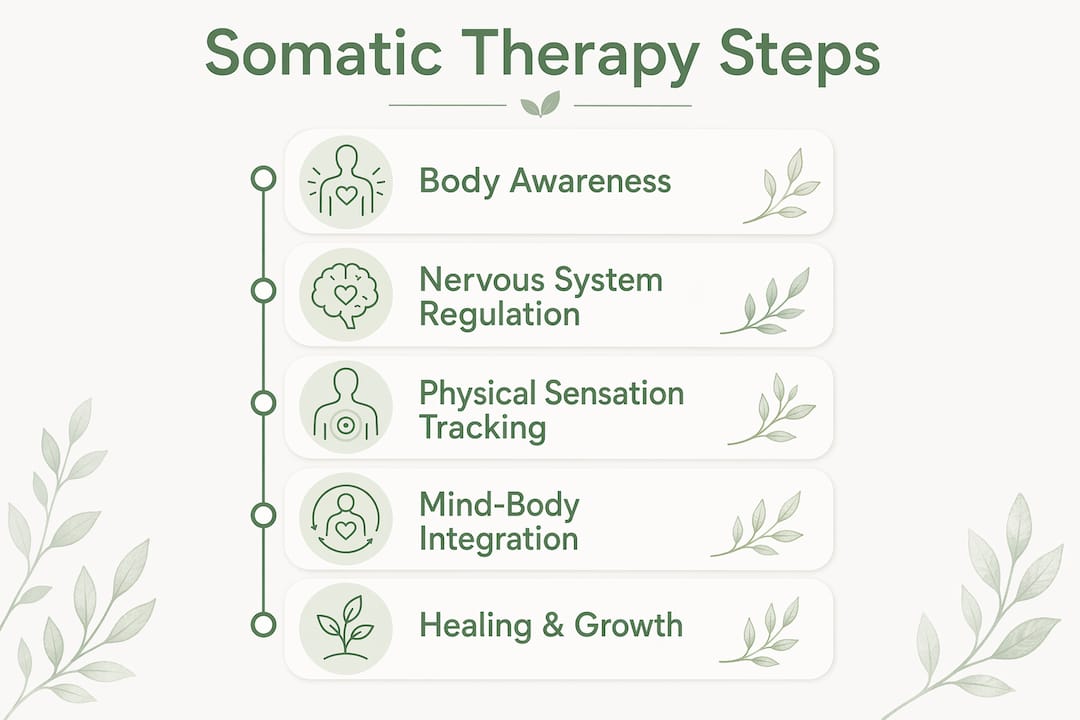
Somatic therapy engages the nervous system through direct physical awareness rather than verbal analysis. A therapist guides you to notice what is happening in your body right now, such as tightness in the chest, shallow breathing, or a sense of heaviness in the legs. That awareness itself begins to shift the nervous system’s response.
Several core techniques drive this process:
Breathwork: Slow, deliberate breathing activates the parasympathetic nervous system, shifting the body out of a stress response.
Grounding: Exercises that connect you to the present moment through physical contact with the floor or chair reduce dissociation.
Pendulation: The therapist guides you to move attention between a distressing sensation and a neutral or pleasant one. This neural retraining technique helps the autonomic nervous system shift from chronic alarm to regulation.
Titration: Trauma is approached in very small doses to prevent retraumatization. Think of it as turning down the volume on a painful memory rather than replaying it at full intensity.
Resourcing: You identify internal or external sources of safety and calm before approaching difficult material.
These techniques, described in detail by Verywell Mind, promote nervous system regulation by building your capacity to tolerate difficult sensations without becoming overwhelmed.
Pro Tip: Pay attention to the subtle signals your body sends during sessions, such as a slight warmth in the hands or a release of tension in the jaw. These small shifts are signs that your nervous system is responding, even when nothing dramatic seems to be happening.
What are the main types of somatic therapies?
Somatic therapies include several distinct modalities, each developed by different clinicians and each with its own techniques. All of them share a focus on body awareness and nervous system regulation.
Somatic Experiencing (SE) was developed by Dr. Peter Levine. It focuses on tracking physical sensations to complete interrupted survival responses, such as the freeze response that occurs during trauma. SE is widely used for PTSD and shock trauma.

Sensorimotor Psychotherapy was developed by Pat Ogden. It integrates body movement and posture with verbal processing. It is particularly effective for developmental and relational trauma, where early experiences shaped physical habits and emotional patterns.
Hakomi was developed by Ron Kurtz. It uses mindfulness and gentle physical experiments to surface unconscious beliefs held in the body. Sessions often involve slow, deliberate movements while the therapist observes physical responses.
Body Psychotherapy is a broader category that includes approaches like Bioenergetics, developed by Alexander Lowen. It works with breath, movement, and physical posture to release chronic muscular tension linked to emotional suppression.
Modality | Core Focus | Best For |
Somatic Experiencing | Completing survival responses | PTSD, shock trauma |
Sensorimotor Psychotherapy | Movement and posture with verbal processing | Developmental trauma |
Hakomi | Mindfulness and physical experiments | Unconscious belief patterns |
Body Psychotherapy | Breath, movement, and muscular release | Chronic tension, emotional suppression |
All four approaches treat the body as a source of information, not just a vessel for the mind. Working with a therapist trained in one of these specific modalities is critical for safe and effective outcomes.
How does somatic therapy compare to traditional talk therapy?
CBT and other talk therapies are highly effective for many conditions. They help you identify distorted thinking, challenge unhelpful beliefs, and build coping strategies. The approach works well when the problem is primarily cognitive, meaning rooted in patterns of thought.
Somatic therapy addresses a different layer. When trauma is physically encoded in the nervous system, verbal reframing alone may not reach it. Somatic therapy’s bottom-up approach targets the parts of the brain that process threat and survival, areas that do not respond to logic or language.
Here is where each approach tends to work best:
Talk therapy (CBT): Anxiety driven by specific thought patterns, phobias, mild to moderate depression, behavioral change goals.
Somatic therapy: PTSD, complex developmental trauma, chronic pain with emotional roots, dissociation, and cases where talk therapy has plateaued.
Combined approach: Integration of somatic and cognitive therapy is often the most effective path for complex developmental trauma, as somatic work builds the body-based foundation that cognitive work then builds upon.
Choosing between the two is not always an either/or decision. Many therapists now integrate elements of both. If you have been in talk therapy for years without fully resolving trauma symptoms, adding a somatic component may be the missing piece.
Pro Tip: When interviewing a new therapist, ask directly: “Do you use a bottom-up or top-down approach?” A therapist who can answer that question clearly has the training to guide you toward the right fit.
What are the benefits and outcomes of somatic therapy?
The benefits of somatic therapy extend across emotional, psychological, and physical health. Research supports its use for a wide range of conditions.
PTSD symptom reduction: A controlled 2017 study found that 15 weekly sessions of Somatic Experiencing produced significant reductions in both PTSD and depression severity compared to a control group.
Chronic pain relief: Breathwork and grounding techniques effectively treat chronic pain by addressing the body’s freeze response, which often underlies persistent physical tension.
Improved emotional regulation: Somatic therapy helps release physical and emotional tension, leading to better emotional regulation and reduced symptoms of anxiety and depression.
Increased body awareness: Clients develop the ability to notice and interpret their own physical signals, which improves decision-making and stress management in daily life.
Nervous system calming: Regular somatic practice trains the nervous system to return to a regulated state more quickly after stress, reducing the overall burden of chronic tension.
“The body keeps the score.” This phrase, popularized by psychiatrist Dr. Bessel van der Kolk, captures why somatic therapy works. The body records experiences that the mind cannot always access through words alone.
These benefits are not instant. Building internal capacity takes time, and most people notice gradual shifts across weeks or months of consistent work. The process is worth the patience.
How to find a somatic therapist and what to expect in sessions
Somatic therapy is a licensed mental health psychotherapy. It is not massage, energy work, or physical manipulation. A qualified somatic therapist holds a clinical license (such as LCSW, LPC, or psychologist) and has completed additional specialized training in a somatic modality.
Effective somatic therapy requires therapists with specialized training. When searching for a provider, look for credentials in Somatic Experiencing (SE), Sensorimotor Psychotherapy, or Hakomi, not just a general claim of “body-centered work.”
A typical session looks like this:
You begin with a brief check-in about your current physical and emotional state.
The therapist guides you to notice sensations in your body without immediately analyzing them.
You may be invited to make small movements, adjust your posture, or try a brief breathing exercise.
Verbal processing follows, connecting physical sensations to emotions or memories.
The session ends with a grounding exercise to help you feel settled before leaving.
Sessions may feel subtle, focusing on slight physiological shifts such as temperature changes or a softening of muscle tension, rather than dramatic emotional releases. That subtlety is intentional. It prevents retraumatization by pacing your engagement with difficult material.
Pro Tip: Before your first session, write down two or three physical sensations you notice when you feel stressed, such as a tight throat or a heavy chest. Sharing these with your therapist gives them a concrete starting point for your body map.
Key Takeaways
Somatic therapy is the most direct path to healing trauma that has been physically encoded in the nervous system, and combining it with cognitive approaches produces the strongest outcomes for complex cases.
Point | Details |
Core definition | Somatic therapy uses body awareness and nervous system regulation to heal trauma and emotional distress. |
Bottom-up mechanism | It targets subcortical brain areas directly, reaching trauma that talk therapy alone cannot access. |
Multiple modalities | Somatic Experiencing, Sensorimotor Psychotherapy, Hakomi, and Body Psychotherapy each address different trauma types. |
Proven outcomes | Research shows 44–90% PTSD symptom reduction and significant depression improvement across structured sessions. |
Qualified therapists matter | Verify that your therapist holds a clinical license and specific somatic modality training before starting. |
Why I believe somatic therapy deserves more attention than it gets
Working in physical rehabilitation in Nassau County, I see patients every week who arrive with chronic pain that has no clear structural cause. Their imaging is clean. Their joints move well. Yet they hurt. What I’ve observed over the years is that a significant portion of persistent physical pain has an emotional and neurological component that standard physical therapy alone does not fully address.
Somatic therapy fills that gap. The growing acceptance of body-oriented approaches in mainstream mental health is not a trend. It reflects a genuine shift in how clinicians understand the nervous system. The science of polyvagal theory, developed by Dr. Stephen Porges, and the trauma research of Dr. Bessel van der Kolk have given somatic therapy a credible scientific foundation that was not as visible a decade ago.
What I tell patients who are curious about somatic work is this: be patient with the subtlety. The sessions do not always feel dramatic. You might leave a session thinking, “Nothing happened.” But over weeks, you notice you sleep better, your shoulders are less tight, and you react to stress with less intensity. That is the nervous system recalibrating. It takes time, and it is real.
Choosing a qualified practitioner is non-negotiable. The field has grown quickly, and not everyone who claims to offer somatic therapy has the clinical training to do it safely. Ask for credentials. Ask about their specific modality training. A skilled somatic therapist will welcome those questions.
— Tj
Somatic and physical therapy at Contemporaryrehabservices
Contemporaryrehabservices is a boutique physical therapy clinic in Albertson, NY, serving patients across Queens and Nassau County. The clinic integrates body-aware treatment approaches with evidence-based physical therapy to address both the structural and neurological roots of pain and dysfunction.
If you are exploring body-oriented healing for chronic pain, tension, or trauma recovery, the team at Contemporaryrehabservices offers personalized treatment plans that go beyond surface-level symptom relief. The clinic accepts Medicare, Aetna, Cigna, Emblem, and United Healthcare plans. Visit the therapy services page to learn more about available treatments, or explore how manual therapy supports pain relief as a complement to somatic approaches.
FAQ
What are somatic therapies in simple terms?
Somatic therapies are body-centered forms of psychotherapy that use physical sensations, breath, and movement to process trauma and emotional distress stored in the nervous system.
Is somatic therapy the same as massage or physical therapy?
No. Somatic therapy is a licensed mental health psychotherapy focused on psychological healing and nervous system regulation. It is distinct from massage or physical manipulation.
How long does somatic therapy take to work?
Research shows significant PTSD and depression improvements after 15 weekly sessions, though symptom reduction can begin within 3 sessions depending on the individual and condition.
Who is somatic therapy best suited for?
Somatic therapy is most effective for people with PTSD, complex trauma, chronic pain with emotional roots, and those who have reached a plateau in traditional talk therapy.
How do I know if a somatic therapist is qualified?
Look for a licensed mental health clinician (LCSW, LPC, or psychologist) with specific somatic modality training in Somatic Experiencing, Sensorimotor Psychotherapy, or Hakomi. Ask directly about their credentials before starting sessions.
Recommended
Comments