
How to Maximize Your Therapy Benefits in 2026

Maximizing your therapy benefits is defined as the active, informed process of collaborating with your therapist, tracking measurable progress, and understanding your insurance coverage to get the greatest possible value from every session. This is not passive. Getting the most from therapy requires you to set clear goals, show up consistently, give honest feedback, and know how your insurance plan works. The therapeutic alliance, which is the trust and shared purpose between you and your therapist, is one of the strongest predictors of successful outcomes. This guide gives you the specific steps, tools, and insurance knowledge to make that happen.
How to maximize your therapy benefits by setting clear goals
The single most effective thing you can do before your first session is decide what you want to achieve. Shared therapy goals build a stronger therapeutic alliance and directly improve outcomes. That means writing down two or three specific outcomes you want, such as managing anxiety at work, improving communication in a relationship, or processing a past event, and bringing that list to your therapist.
Therapy is a process, not a quick fix. Many people enter their first session expecting relief within a few weeks and disengage when progress feels slow. A more realistic frame is to think of therapy the way you think of physical rehabilitation: early sessions build the foundation, and results compound over time. Mutually agreed goals and genuine understanding between you and your therapist form the core of a strong therapeutic alliance, which research consistently links to successful outcomes.
Goals also need to be revisited. If you feel stuck after several sessions, that is not a sign to quit. It is a signal to renegotiate. Proactively renegotiating goals or discussing alternative approaches early, rather than waiting months, prevents wasted time and frustration. Ask your therapist directly: “Are we still working toward the right goal, and is this approach the best way to get there?”
Write down your top two or three goals before your first session
Ask your therapist what type of therapy they use and why it fits your goals
Review your goals together every four to six weeks
If progress stalls, ask about alternative methods or adjusted timelines rather than stopping
Pro Tip: Ask your therapist to put your goals in writing at the start of treatment. A written goal statement gives both of you a shared reference point and makes it easier to recognize real progress.
What is measurement-based care and how does it improve results?
Measurement-based care, commonly called MBC, is a clinical practice where clients complete short, standardized questionnaires before each session to provide objective data about their symptoms and progress. The American Psychological Association explains that MBC uses quantitative data to help therapists adjust goals, change approaches, or determine when treatment is complete. This is one of the most underused tools available to therapy clients today.

The practical benefit is transparency. Without MBC, progress in therapy often feels invisible because it relies entirely on subjective impressions. One week you feel better, the next you feel worse, and it becomes hard to tell whether therapy is actually working. Objective check-ins let you and your therapist see patterns across weeks and months rather than reacting to single sessions. Clients who use MBC report feeling more in control of their treatment because the data belongs to them too.
Without MBC | With MBC |
Progress tracked by feeling alone | Progress tracked with standardized scores |
Therapist adjusts based on session tone | Therapist adjusts based on trend data |
Hard to know when therapy is complete | Clear benchmarks signal treatment milestones |
Client feels passive in the process | Client actively reviews their own data |
If your therapist does not currently use MBC, you can ask about it directly. Common tools include the PHQ-9 for depression and the GAD-7 for anxiety. Asking therapists to operationalize progress into measurable terms, rather than relying on subjective feelings alone, is one of the most concrete ways to enhance therapy effectiveness.
Pro Tip: Even if your therapist does not use formal MBC tools, you can track your own progress by rating your primary symptom on a scale of 1 to 10 before each session and noting the number in a journal. Bring that log to your sessions.
Best practices for engagement: preparing, attending, and reflecting
Active engagement between sessions is often the difference between therapy that changes your life and therapy that simply passes the time. Between-session accountability, which means reflecting on sessions and connecting real-life events to your therapy work, is what separates superficial sessions from transformative ones. The work does not stop when you leave the office.
Here is a practical engagement routine that works:
Prepare before each session. Spend five minutes reviewing your notes from the previous session. Identify one or two things that came up in your daily life that connect to your therapy goals.
Attend consistently. Regular attendance and articulating goals are two of the most reliable predictors of better therapy outcomes. Skipping sessions breaks momentum and forces you to spend time recapping rather than progressing.
Take notes during sessions. Write down key insights, phrases your therapist uses, or moments that feel significant. These notes become the raw material for your between-session reflection.
Reflect after each session. Within 24 hours, write a short paragraph about what stood out. Ask yourself: “What did I learn today, and where did I see this pattern in my life this week?”
Bring your reflections back. Taking notes and bringing them to sessions tracks progress and helps therapy flow more naturally from one session to the next.
This routine takes less than 15 minutes per day and dramatically increases the return on every hour you spend in the therapy room. Think of it as the homework that makes the class worth attending.
How to give feedback that actually improves your sessions
Giving your therapist honest feedback is one of the most underrated ways to improve therapy results. Many clients assume the therapist always knows best and stay silent when something is not working. Openly communicating with your therapist about what is or is not helpful allows sessions to be tailored specifically to your needs.
Focusing sessions on what matters most to you, rather than feeling obligated to cover every topic, maximizes the benefit of each hour. You are allowed to say, “I want to focus on this specific issue today,” or “That exercise did not feel useful for me.” Therapists expect this kind of input and use it to adjust their approach.
Here are specific ways to give effective feedback:
Tell your therapist which parts of sessions feel most helpful and which feel less relevant
If a technique feels uncomfortable or unhelpful, say so in the moment rather than waiting
Ask your therapist to explain the reasoning behind a specific approach so you understand the purpose
If you feel the relationship lacks trust or empathy, name it directly. The therapeutic alliance depends on honesty from both sides
If the fit feels genuinely wrong after several honest conversations, seeking a different therapist is a legitimate and healthy choice
Transparent treatment planning, which includes discussing goals, progress metrics, methods, and contingency plans, increases therapy success. You can also explore therapy options and fit before committing to a specific approach.
How to navigate insurance and get reimbursed for therapy
Understanding your insurance coverage is a practical skill that directly affects how long you can afford to stay in therapy. Out-of-network (OON) coverage is the most commonly misunderstood benefit. Out-of-network reimbursement requires paying your therapist upfront, obtaining a superbill, submitting a claim to your insurer, and understanding how your allowed amount, deductible, and coinsurance interact. Each of these steps matters.
Here is how the process works in plain terms. Your insurer sets an “allowed amount,” which is the maximum they will recognize for a given service. Your therapist may charge more than that, and the difference is your responsibility. Once you meet your deductible, your insurer pays a percentage of the allowed amount, called coinsurance, typically 70 to 80 percent. Understanding allowed amounts and deductible rules is vital for avoiding unexpected costs and planning how many sessions you can realistically afford.
Insurance term | What it means for you |
Allowed amount | The maximum your insurer will recognize per session |
Deductible | The amount you pay before insurance coverage begins |
Coinsurance | Your share of costs after meeting the deductible |
Superbill | An itemized receipt your therapist provides for claim submission |
Pro Tip: Call your insurance company before starting therapy and ask three specific questions: What is my out-of-network deductible? What is my coinsurance rate for mental health services? And what is the allowed amount for CPT code 90837, which is the standard 60-minute therapy session code?
Contemporaryrehabservices accepts Medicare, Aetna, Cigna, Emblem, and United Healthcare plans, which removes much of this complexity for clients in Albertson, NY, Queens, and Nassau County.
Key takeaways
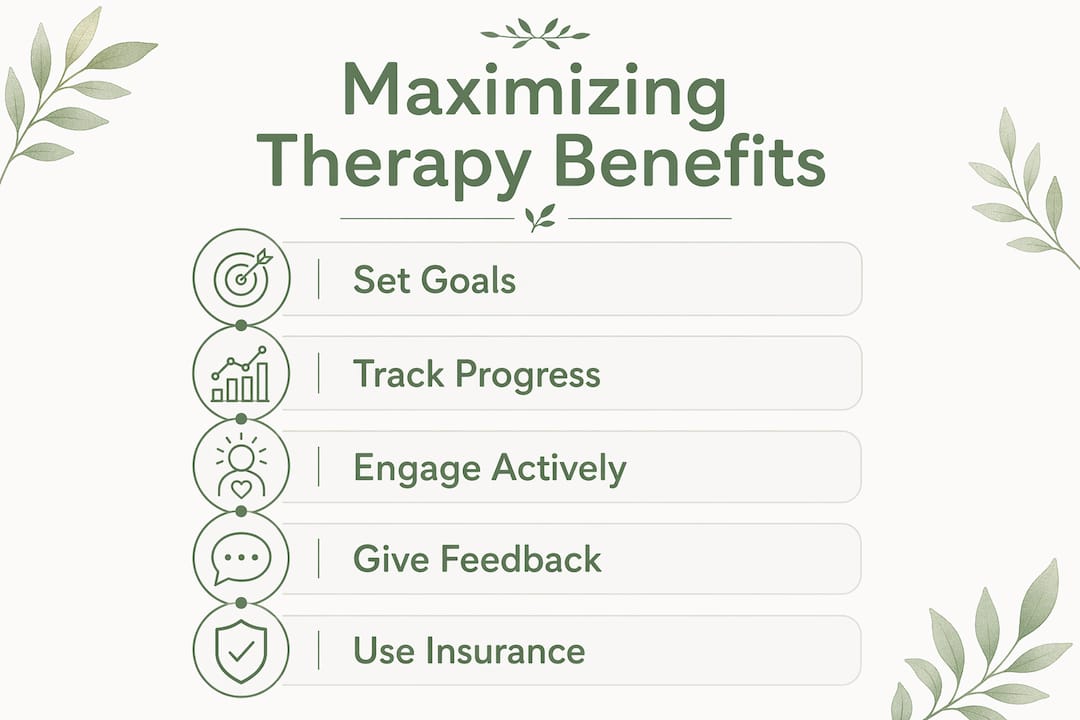
Active participation, measurable tracking, and insurance literacy together determine how much value you extract from therapy.
Point | Details |
Set written goals early | Bring two or three specific goals to your first session and review them every four to six weeks. |
Use measurement-based care | Ask your therapist about MBC tools like the PHQ-9 or GAD-7 to track progress objectively. |
Engage between sessions | Reflect, take notes, and connect daily life to therapy work within 24 hours of each session. |
Give honest feedback | Tell your therapist what is and is not working so sessions can be adjusted to your actual needs. |
Know your insurance terms | Understand your deductible, allowed amount, and coinsurance before your first session to avoid surprises. |
What I have learned from watching clients transform their therapy experience
After years of working in rehabilitation and seeing clients move through all kinds of therapeutic processes, the pattern is clear. The clients who get the most from therapy are not the ones with the most severe problems or the most talented therapists. They are the ones who treat therapy as a collaboration rather than a service they receive passively.
The therapeutic alliance is not a soft concept. It is the mechanism through which change happens. When clients come in with written goals, ask hard questions, and give honest feedback, therapists can do their best work. When clients sit back and wait to be fixed, even the best clinician is working with one hand tied behind their back.
Measurement-based care changed how I think about progress tracking. Before I understood MBC, I relied too heavily on how a client seemed in the room. A client can appear fine and still be struggling. The data tells a different story, and that story is more useful. I encourage every person in therapy to ask their provider about standardized progress measures. It is a simple request that signals you are serious about results.
On insurance, my honest advice is this: do not let confusion about coverage stop you from continuing therapy that is working. Learn the three or four terms that matter, make one phone call to your insurer, and you will have enough information to make a confident decision. The practical therapy tips that apply to physical recovery apply here too. Preparation and consistency are what drive outcomes.
— Tj
Start getting more from every therapy session with Contemporaryrehabservices
If you are ready to put these strategies into practice, Contemporaryrehabservices makes it straightforward. The boutique physical therapy clinic in Albertson, NY serves clients across Queens and Nassau County with personalized, evidence-based care designed around your specific goals.

The team at Contemporaryrehabservices works with you to align treatment goals, track measurable progress, and make the most of your coverage. The clinic accepts Medicare, Aetna, Cigna, Emblem, and United Healthcare plans, so insurance navigation is handled with you, not left to you alone. Whether you are starting therapy for the first time or looking to get better results from an existing plan, the Albertson therapy location and the Searingtown clinic are both accepting new clients. Explore the full range of available therapy services and take the first step toward results you can actually measure.
FAQ
What does it mean to maximize your therapy benefits?
Maximizing your therapy benefits means actively collaborating with your therapist through clear goal-setting, consistent attendance, honest feedback, and progress tracking to get the greatest possible value from each session.
How does measurement-based care help in therapy?
Measurement-based care uses short standardized questionnaires, such as the PHQ-9 or GAD-7, to track symptom changes objectively before each session, giving both client and therapist data to guide treatment decisions.
How often should I attend therapy to see real results?
Consistent, regular attendance is one of the strongest predictors of better therapy outcomes. Missing sessions breaks momentum and reduces the cumulative benefit of the therapeutic process.
What is a superbill and why do I need one?
A superbill is an itemized receipt your therapist provides that includes diagnosis and procedure codes. You submit it to your insurance company to receive reimbursement for out-of-network therapy sessions.
When should I consider switching therapists?
If you have had several honest conversations about what is not working and the therapeutic alliance still feels misaligned, seeking a different therapist is a healthy and legitimate choice, not a failure.
Recommended
Comments