
Your step-by-step guide to checking PT eligibility

Few things are more discouraging than finally committing to physical therapy, only to receive a denial letter from your insurance company weeks later. Maybe you assumed your coverage would take care of it. Maybe someone told you Medicare always covers physical therapy. The reality is more complicated, and the paperwork can feel like a maze. If you live in Queens or Nassau County and you’re wondering whether your Medicare, Medicare Advantage, Medicaid, Aetna, Cigna, Emblem, or United Healthcare plan will pay for physical therapy, this guide walks you through each step clearly, so you can start treatment with confidence instead of confusion.
Table of Contents
Key Takeaways
Point | Details |
Coverage type matters | Your path for checking eligibility depends on your insurance—Medicare, Medicaid, or private plans each have different requirements. |
Check documentation | Eligibility always requires proof like a provider-certified plan and sometimes prior authorization. |
Avoid common mistakes | Missing paperwork or neglecting pre-approval is a top cause of therapy coverage denials. |
Confirm approval | Always verify insurance confirmation before starting physical therapy to prevent surprise bills. |
Get help if denied | Appeals and provider support can reverse eligibility issues if you act promptly. |
What you need before you start
Now that you know why checking eligibility is crucial, let’s cover what you need in advance.
Before you pick up the phone or log into your insurance portal, gathering the right information makes the whole process faster and less stressful. Think of this as laying out your tools before starting a home repair. Skipping even one item can bring the process to a grinding halt and delay your care.
Here is what you need to have on hand:
Your insurance or Medicare card. This has your member ID, group number, and plan type, all of which a provider’s billing team will need.
Your primary care provider’s information. Some plans require a referral from your doctor before approving physical therapy.
The name and NPI (National Provider Identifier) number of the physical therapy clinic you want to visit. Providers must be in-network for most plans to cover services at the highest benefit level.
Any prior authorization forms your plan uses. These vary by insurer and are sometimes plan-specific.
Your diagnosis or reason for seeking therapy. Insurers need a medical justification tied to a specific condition or injury.
Your plan’s member handbook or summary of benefits. This document outlines what is and is not covered under your specific plan.
Knowing your coverage type matters just as much as having your card. Whether you have Original Medicare, Medicare Advantage (also called Part C), New York Medicaid, or a commercial plan like Aetna or Cigna changes the rules you are working with. Choosing physical therapy and insurance wisely means understanding which rules apply to you before you sit down in a therapy clinic.
Therapy eligibility in practice often depends on payer-specific administration, including verifying that the plan is active, that the therapy service is a covered benefit, and that any referral or prior authorization requirements are met before or during the episode of care. Missing one of these details is often all it takes to turn a covered visit into an unexpected bill.
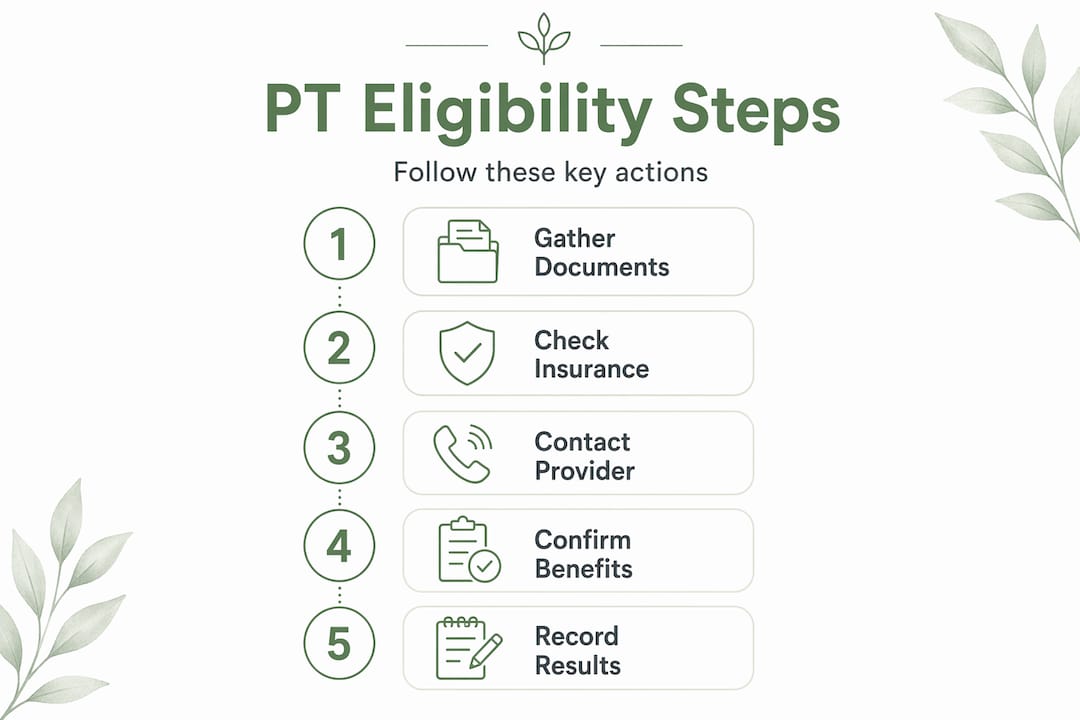
Pro Tip: Create a simple folder, physical or digital, with copies of all the items listed above. Update it every January when your plan may change. Bring it to every provider visit. This single habit can prevent most eligibility headaches before they start.
Document or detail needed | Why it matters |
Insurance or Medicare card | Confirms your plan type and member ID |
Referral from primary care provider | Required by many Medicare Advantage and HMO plans |
Provider NPI number | Verifies the clinic is in-network |
Prior authorization form | Needed before therapy starts for many plans |
Diagnosis or condition | Medical justification for therapy |
Summary of benefits | Defines what is and is not covered |
Step-by-step: How to check eligibility for Medicare, Medicaid, and insurance
With your materials ready, you are set to follow the right steps depending on your coverage. The path looks a little different for each plan type, so use the section that matches your situation.
Original Medicare (Parts A and B)
Confirm you have active Medicare Part B enrollment, since outpatient physical therapy falls under Part B, not Part A.
Ask your doctor to certify that therapy is medically necessary and to write a plan of care. Medicare outpatient physical therapy is covered under Part B when a qualified provider certifies medical necessity and creates a plan of care for your condition.
Confirm the physical therapy clinic accepts Medicare assignment, meaning they agree to Medicare’s approved payment rates.
Ask about your Part B deductible and coinsurance. For 2026, you typically pay 20% of the Medicare-approved amount after meeting your annual deductible.
No referral is required under Original Medicare, but your therapist does need a signed plan of care from a physician or other qualified provider.
Medicare Advantage (Part C)
Call the member services number on the back of your card and ask specifically about physical therapy benefits for outpatient care.
Confirm the PT clinic you want to use is in the plan’s network. The provider network importance cannot be overstated here. Out-of-network care under Medicare Advantage is often dramatically more expensive or not covered at all.
Ask if prior authorization is required before your first visit. Medicare Advantage plans have their own coverage rules, including network restrictions and prior authorization requirements, separate from Original Medicare.
Request the authorization in writing before scheduling treatment.
Confirm any copays, visit limits, or annual benefit caps that apply to physical therapy under your specific plan.
New York Medicaid
Confirm your Medicaid enrollment is active through the New York State of Health marketplace or your managed care plan.
New York Medicaid eligibility for residents in Queens and Nassau County is primarily based on financial eligibility rules, not your county. Your managed care plan’s rules determine how therapy is accessed.
Contact your Medicaid managed care plan directly to find out which PT providers are in-network and whether a referral is needed.
Ask if prior authorization is required. Many managed care plans require it even for Medicaid-covered services.
Confirm any small copay amounts that may apply for your eligibility category.
Commercial insurance (Aetna, Cigna, Emblem, United Healthcare)
Log into your insurer’s member portal or call member services to confirm physical therapy is a covered benefit under your plan.
Confirm you have met or are aware of your deductible status for the year.
Verify that your preferred PT clinic is in-network.
Ask if a referral or prior authorization is needed before starting care.
Request a reference number for the call and keep a record of what the representative confirmed.
Pro Tip: If you are on Medicare Advantage or Medicaid managed care, never assume the same rules as Original Medicare apply. Always call your plan directly before scheduling your first appointment. A 10-minute call can prevent a very unpleasant surprise.
Coverage type | Referral needed? | Prior auth required? | Key eligibility check |
Original Medicare | No | Rarely | Active Part B, medically necessary plan of care |
Medicare Advantage | Often yes | Frequently yes | In-network provider, plan-specific rules |
NY Medicaid | Depends on plan | Often yes | Active enrollment, managed care plan rules |
Commercial (Aetna, Cigna, etc.) | Sometimes | Sometimes | In-network status, deductible, plan benefits |
Common mistakes and how to avoid eligibility denials
Even with all steps followed, eligibility can still be tripped up by common mistakes. Here’s what to watch out for.
These are the errors we see most often, and they are nearly always preventable:
Incomplete or missing documentation. A claim without the right paperwork is almost certain to be denied. Always confirm what your provider submitted.
No certified plan of care for Medicare. Medicare Part B physical therapy is covered only when therapy is considered reasonable and medically necessary, with proper documentation. Without that certified plan of care from a qualifying provider, Medicare can refuse payment entirely.
Skipping prior authorization. If your plan requires it, starting therapy without it means you may owe the full cost out of pocket.
Assuming Medicaid rules are location-based. Many patients in Queens and Nassau County believe that where they live determines what Medicaid will cover. That is not accurate. Eligibility is based on your financial situation and eligibility category, not your ZIP code or borough.
Not asking about an Advance Beneficiary Notice (ABN). An ABN is a written notice that Medicare may not pay for a service. If your provider does not give you one when it is required and Medicare denies the claim, you could still owe nothing. But if the ABN process is handled incorrectly, you may be fully responsible for the bill.
Important: A denied claim can leave you responsible for the full cost of your physical therapy sessions. That can add up to hundreds or even thousands of dollars. Always verify eligibility and authorization before your first visit, not after.
Matching therapy with your insurance properly from the start is what separates a smooth care experience from a financial headache. When Medicare Advantage or Medicaid managed care plans require prior authorization, verifying ahead of time avoids delays and denials even when the therapy is medically necessary from a clinical standpoint.
Pro Tip: Always confirm with your physical therapy provider whether an ABN or prior authorization is needed before your first session. Make it a habit, not an afterthought.
How to verify your eligibility status and what happens next
Once you have taken the right steps and avoided errors, it is time to make sure your eligibility is confirmed and you know what to expect next.
Here is how to follow through after you have done the initial checks:
Call your insurer to confirm approval. If prior authorization was submitted, call to confirm it was approved and ask for the authorization number.
Request an approval letter. Keep this on file. It is your proof that the insurer agreed to cover services.
Review your Explanation of Benefits (EOB). After each visit, your insurer should send an EOB showing what was billed, what was approved, and what you owe.
Understand your cost sharing. Original Medicare Part B requires you to pay your annual deductible first and then 20% coinsurance on approved amounts. Commercial plans vary widely.
If denied, act quickly. Ask your insurer for the specific reason in writing. Contact your provider to check for missing documentation. File a formal appeal within the timeframe your plan requires, which is usually 30 to 60 days. Your provider’s billing team can often help advocate on your behalf.
For Medicaid patients, the New York State Medicaid program notes that some services may not be covered depending on your age, financial situation, family status, or living arrangements, and that small copays may apply for some services, with differences for managed care enrollees.
Explore physical therapy facts for Queens and Nassau if you want more context on how PT benefits older adults in our area and why coverage verification is such an important first step.

What approval or denial looks like | Original Medicare | Medicare Advantage | NY Medicaid | Commercial plan |
Approval document | Explanation of Benefits | Written auth letter | EOB from managed care plan | Auth letter or EOB |
Who handles denials | Medicare | Your plan’s appeals dept. | Managed care plan | Insurer appeals process |
Typical cost after approval | 20% coinsurance | Copay per visit | Small copay or none | Copay, deductible |
Appeal deadline | 120 days | 60 days | 90 days | 30 to 60 days |
Why eligibility checks save more trouble than you think
Most people treat eligibility verification as a bureaucratic task, something to get through before the “real” work of therapy begins. We want to offer a different way to think about it.
In our experience working with patients across Queens and Nassau County, the patients who face unexpected bills almost never skipped the process on purpose. They simply assumed everything would work out, or they trusted that someone else, the front desk, the referring doctor, the insurer, had already handled it. That assumption is expensive.
We have seen patients in Nassau County avoid bills of over $2,000 simply by calling their Medicare Advantage plan before scheduling and learning that a specific clinic was out of network. We have also seen the reverse: patients who did not call and received surprise statements after six weeks of care.
The empowering physical therapy facts available to older adults in our region are genuinely remarkable. Physical therapy improves mobility, reduces pain, and can even prevent costly surgeries. But none of that benefit reaches you if a coverage denial stops you from completing your care plan.
There is also a less obvious benefit to diligent eligibility checks: peace of mind. When you know your coverage is confirmed, you can focus fully on getting better instead of worrying about what the bill will look like. That psychological ease actually supports recovery. Stress and anxiety can slow healing. A confirmed authorization removes one major source of stress before your first session.
“The cost of a 10-minute phone call can be thousands in savings.”
Pro Tip: Treat your eligibility check like preventive care for your finances. Just as you would not skip a cholesterol screening, do not skip verifying your PT coverage. Do it before every new episode of care, even if you checked last year.
Need help with eligibility or booking physical therapy?
If you have read this far and still feel uncertain about your coverage, you are not alone. Insurance language is confusing by design, and eligibility rules change from year to year.
At CRS Wellness, our team in Albertson, NY helps Medicare, Aetna, Cigna, Emblem, and United Healthcare patients across Queens and Nassau County navigate exactly this process. We verify your insurance before your first visit so there are no surprises. Whether you have questions about prior authorization, in-network status, or simply want to know if we accept your plan, we are here to walk you through it. Visit our Albertson physical therapy services page to learn more about what we offer, or explore our full range of CRS therapy treatments to find the right care path for your condition. Reach out today and let us take the guesswork out of getting started.
Frequently asked questions
What documents do I need to check my physical therapy eligibility?
You will need your insurance or Medicare/Medicaid card, your provider’s information, and any prior authorization forms required by your specific plan. Therapy eligibility verification also requires confirming that the plan is active, the service is a covered benefit, and all referral requirements are met.
Does Medicare always cover outpatient physical therapy?
Medicare Part B covers outpatient physical therapy when it is medically necessary and a qualified provider certifies a plan of care. Medicare Part B coverage requires proper documentation and a clinician’s certification that therapy is reasonable and necessary for your condition.
How does Medicaid in Queens and Nassau decide eligibility for PT?
Eligibility is based on your financial situation and eligibility category, not your county of residence. New York Medicaid eligibility for physical therapy also depends on your managed care plan’s network and authorization rules.
What if my therapy claim is denied?
Contact your insurer and your physical therapy provider right away to identify any missing documentation or authorization issues. Insurance therapy denials are often tied to missing referrals, inactive coverage, or failed authorization steps, all of which can be appealed with proper documentation.
Is prior authorization always needed for physical therapy?
Not always, but it depends entirely on your specific plan. Prior authorization for therapy is especially common under Medicare Advantage and Medicaid managed care plans, and confirming ahead of time prevents unexpected denials even when therapy is clinically necessary.
Recommended
Merci pour ce guide très clair qui rend la vérification de l'admissibilité au traitement tellement plus simple et accessible pour nous tous. stone vegas casino france (
Mình có lần lướt đọc mấy trao đổi trên mạng شيخ روحاني thì thấy nhắc nên cũng tò mò mở ra xem thử cho biết. Mình không tìm hiểu sâu جلب الحبيب chỉ xem qua trong thời gian ngắn để quan sát bố cục جلب الحبيب cách sắp xếp شيخ روحاني các mục và trình bày nội شيخ روحاني dung tổng thể. Cảm giác là các phần được trình bày khá gọn, các Huren Berlin mục rõ ràng nên đọc lướt cũng không bị rối với mình như Hurentest Berlin vậy là đủ để nắm tin cơ bản rồi. جلب الحبيب
,
,
Часом знаходжу ці джерела випадково, іноді хтось скине в чат, іноді сам зберігаю “на потім”. Частину переглядаю рідко, частину — коли шукаю щось локальне чи нестандартне. Вони різні: новини, огляди, думки, регіональні стрічки. Я не беру все за правду — скоріше, для порівняння та пошуку контрасту між подачею. Можливо, хтось іще знайде серед них щось цікаве або принаймні нове. Головне — мати з чого обирати. Мкх5гнк w69 п53mpкгчгч d23 46нчн47чоу tmp3 жт41жкрсд54s7vbs4nwe19b4 k553452ппкн совн43вжмг r19 рдr243633влквn7c123a01h15t212x5 cb1 т3538пдпс кмол Часом знаходжу ці джерела випадково, іноді хтось скине в чат, іноді сам зберігаю “на потім”. Частину переглядаю рідко, частину — коли шукаю щось локальне чи нестандартне. Вони різні: новини, огляди, думки, регіональні стрічки. Я не беру все за правду —…
Мкх5гнк w69 п53mpкгчгч d23 46нчн47чоу tmp3 жт41жкрсд54s7vbs4nwe19b4 k553452ппкн совн43вжмг r19 рдr243633влквn7c123a01h15t212x5 cb1 т3538пдпс кмол Часом знаходжу ці джерела випадково, іноді хтось скине в чат, іноді сам зберігаю “на потім”. Частину переглядаю рідко, частину — коли шукаю щось локальне чи нестандартне. Вони різні: новини, огляди, думки, регіональні стрічки. Я не беру все за правду — скоріше, для порівняння та пошуку контрасту між подачею. Можливо, хтось іще знайде серед них щось цікаве або принаймні нове. Головне — мати з чого обирати.
Часом знаходжу ці джерела випадково, іноді хтось скине в чат, іноді сам зберігаю “на потім”. Частину переглядаю рідко, частину — коли шукаю щось локальне чи нестандартне. Вони різні: новини, огляди, думки, регіональні стрічки. Я не беру все за правду — скоріше, для порівняння та пошуку контрасту між подачею. Можливо, хтось іще знайде серед них щось цікаве або принаймні нове. Головне — мати з чого обирати. Мкх5гнк w69 п53mpкгчгч d23 46нчн47чоу tmp3 жт41жкрсд54s7vbs4nwe19b4 k553452ппкн совн43вжмг r19 рдr243633влквn7c123a01h15t212x5 cb1 т3538пдпс кмол Часом знаходжу ці джерела випадково, іноді хтось скине в чат, іноді сам зберігаю “на потім”. Частину переглядаю рідко, частину — коли шукаю щось локальне чи нестандартне. Вони різні: новини, огляди, думки, регіональні стрічки. Я не беру все за правду —…