
How Physical Therapy Accelerates Injury Recovery
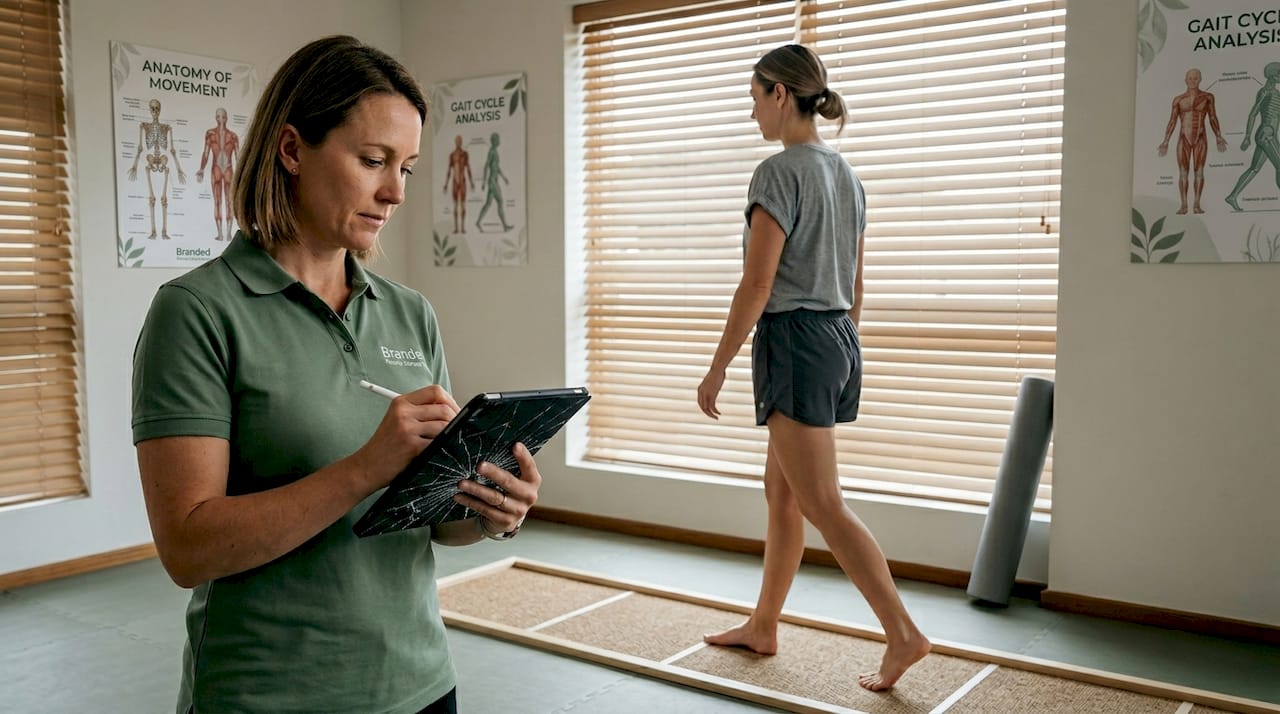
Physical therapy is one of the most underused tools in injury recovery, especially for people dealing with musculoskeletal pain in Queens and Nassau County. Many patients assume rest, medications, or a quick injection will solve the problem. But tailored rehabilitation programs restore strength, mobility, neuromuscular control, and overall function while reducing the chance of getting hurt again. This guide breaks down exactly how physical therapy works, why the research backs it so strongly, and what you can expect when you start a structured program here on Long Island.
Table of Contents
What makes physical therapy so effective for injury recovery?
PT vs. pain medications and injections: Evidence-based outcomes
The importance of early physical therapy: Timing, results, and risk reduction
Physical therapy for different injury types: Customization and patient experience
Taking the next step: Finding expert physical therapy near you
Key Takeaways
Point | Details |
PT outperforms medications | Physical therapy delivers better pain reduction and long-term recovery compared to medications or injections. |
Early PT improves outcomes | Starting physical therapy soon after injury maximizes functional recovery and reduces the chance of re-injury. |
Customization boosts results | Personalized physical therapy plans address each injury type for more effective healing and prevention. |
PT benefits all injuries | Even minor injuries benefit from PT to restore movement and prevent future problems. |
Local clinics offer expert care | Accessible PT in Queens and Nassau County provides evidence-based recovery tailored to your needs. |
What makes physical therapy so effective for injury recovery?
Physical therapy is not simply a set of exercises you do on a mat. It is a science-driven process that evaluates how you move, where your body is weak, and what your nervous system has lost after an injury. Each program is built around your specific condition, your goals, and your daily life. That level of personalization is what separates PT from generic fitness or pain management.
Your path to recovery through physical therapy typically addresses four key areas:
Strength restoration: Targeted exercises rebuild muscle that weakens after injury or surgery.
Mobility improvement: Manual therapy, stretching, and movement training restore your full range of motion.
Neuromuscular control: This is the brain-body connection that keeps your joints stable. Injuries disrupt it. PT rebuilds it.
Functional recovery: You practice real-life movements so you can return to work, sports, or daily tasks safely.
The results speak for themselves. Research shows that structured PT programs deliver 86% pain reduction, 80% improvement in range of motion, 74% functional recovery, and a 64% return-to-sport rate, with only a 9% re-injury rate. Those numbers reflect what happens when rehabilitation is done correctly and consistently.
“Physical therapy is most effective when started early. Waiting for pain to become unbearable before seeking care often means a longer, harder recovery road.”
Understanding why expert PT changes healing also means recognizing that therapists assess movement patterns, identify compensation habits, and address the root cause of your injury, not just the symptom.
Pro Tip: If you have been injured, even mildly, reaching out to a physical therapist within the first week gives your body the best possible start. Early engagement consistently produces better outcomes than a “wait and see” approach.
PT vs. pain medications and injections: Evidence-based outcomes
Understanding PT’s mechanism, let’s now see how it stacks up against common alternatives in real-world outcomes.
Many people reach for pain medications or ask for a cortisone injection because results feel immediate. Pain fades. The problem seems solved. But those approaches mask the symptom rather than fix the underlying issue. When the medication wears off or the injection effect fades, the same weakness and dysfunction remain, and sometimes worsen.
The data is clear. Long-term injury resolution was reported by 73% of PT users compared to those relying on pain medications, and 68% of patients who tried both methods preferred PT for sustained recovery. Those are not small differences. They represent real people who got lasting relief through movement-based care rather than chemical management.
PT also outperforms injections for specific conditions. Research shows that PT outperforms glucocorticoid injections for meniscal tears and knee osteoarthritis across WOMAC scores (a standardized measurement of pain, stiffness, and function), pain levels, proprioception (your body’s ability to sense joint position), and overall quality of life at one year. One year out, PT patients were doing measurably better.
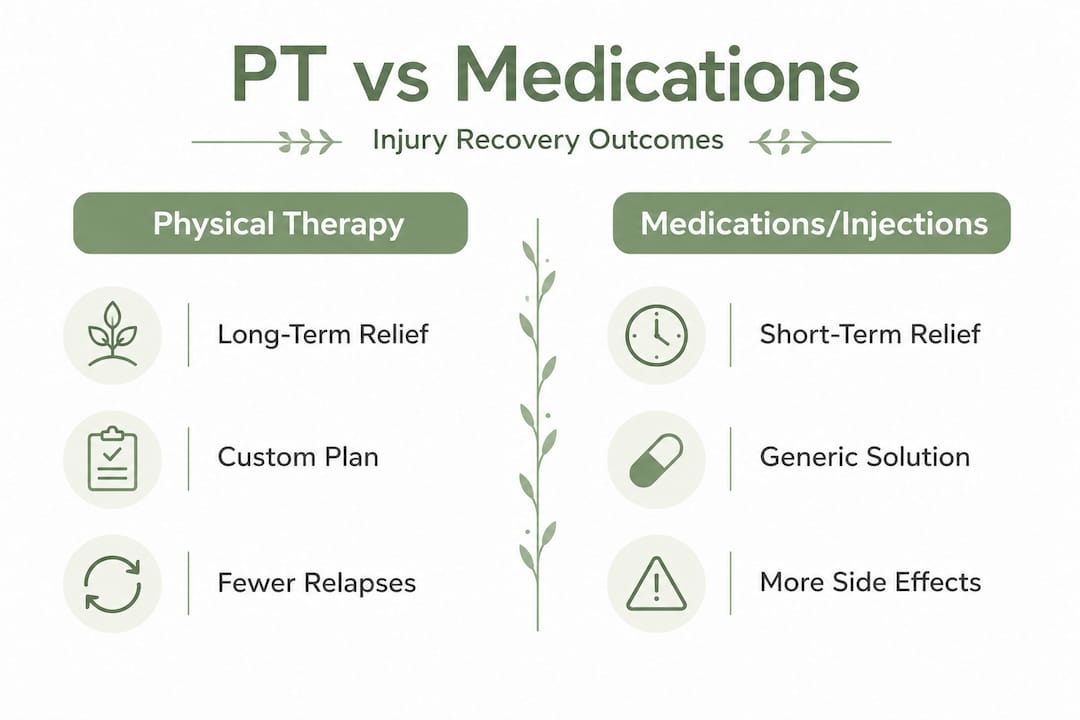
Here is a side-by-side look at how these approaches compare:
Outcome Measure | Physical Therapy | Pain Medications | Glucocorticoid Injections |
Long-term pain reduction | High (86%) | Moderate, short-term | Moderate, fades at 6 months |
Functional recovery | High (74%) | Low | Low to moderate |
Quality of life improvement | High | Low | Moderate (short-term) |
Re-injury risk | Low (9%) | Not addressed | Not addressed |
Patient preference (long-term) | 68% prefer PT | 32% prefer meds | Varies |
Proprioception restoration | Yes | No | No |
This table makes one point very clearly. If your goal is to feel better next week, medications might seem appealing. If your goal is to move well, stay active, and avoid repeat injury over the next year, PT is the stronger choice.
“Physical therapy plays a meaningful role in reducing opioid dependence. When patients have access to effective, non-pharmacological care, they are less likely to rely on prescription pain management, which carries serious long-term risks.”
For those dealing with knee pain specifically, PT’s advantages over injections are particularly significant. The same applies to people managing chronic neck or back pain, where sustained movement retraining outperforms medication-based approaches for lasting relief.
The importance of early physical therapy: Timing, results, and risk reduction
Comparing outcomes leads to one critical variable. When PT begins can make all the difference.
The timing of when you start physical therapy after an injury is not a minor detail. It significantly shapes how fully you recover, how quickly you return to activity, and how well your body holds up over time. The research on ACL (anterior cruciate ligament) reconstruction recovery makes this especially clear.
Early PT after ACL reconstruction improves IKDC scores (a standardized knee function assessment), quadriceps strength, knee range of motion, proprioception, and return-to-sport rates, all without compromising graft integrity. In other words, starting rehabilitation soon after surgery is not just safe. It actively accelerates recovery in every measurable category.
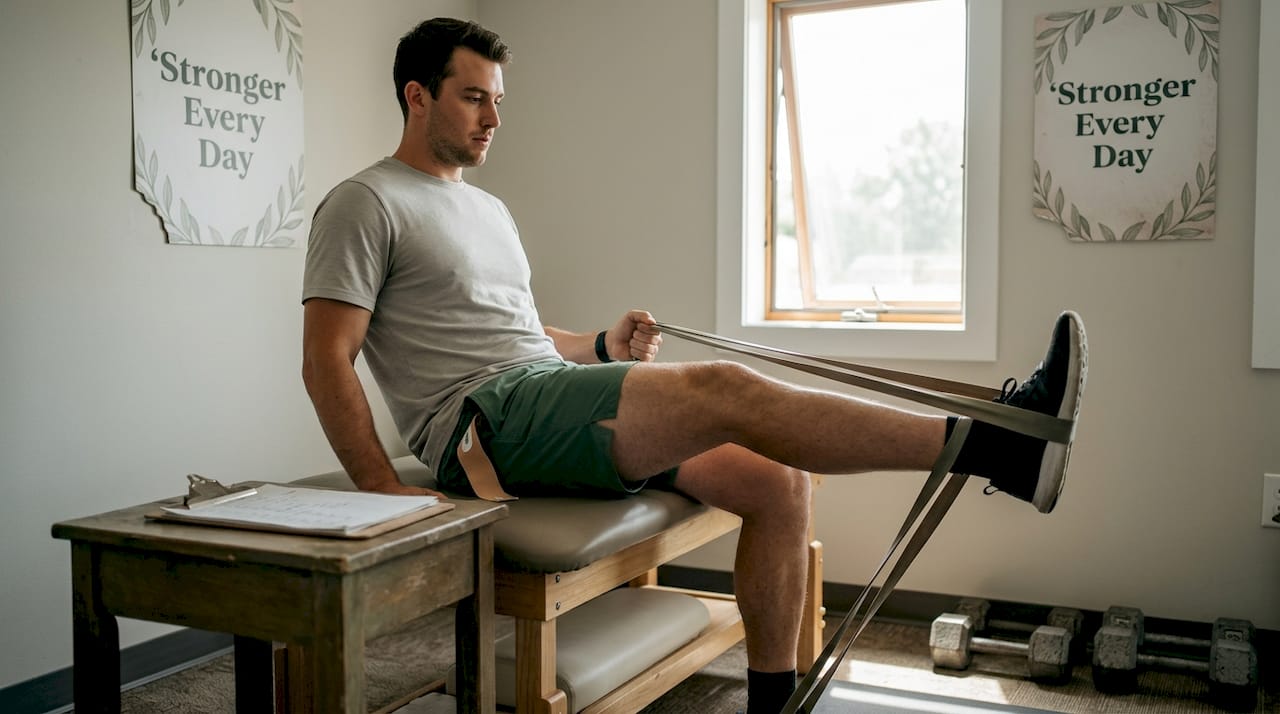
Here is how early PT compares to delayed PT in ACL recovery:
Recovery Measure | Early PT (within 2 weeks) | Delayed PT (after 6+ weeks) |
IKDC functional score | 85.6 | 80.4 |
Quadriceps strength recovery | Significantly higher | Lower |
Knee range of motion | Restored faster | Slower recovery |
Proprioception | Better | Reduced |
Return-to-sport rate | 79% | 65% |
The gap between early and delayed PT is meaningful. A 14-point difference in return-to-sport rates is the difference between getting back on the field and sitting on the sideline for an extended period.
If you have recently been injured or had surgery, here are the steps to get PT started early:
Talk to your doctor immediately. Ask specifically when PT can begin, even if it is gentle movement work before formal rehabilitation.
Contact a licensed physical therapist within the first week. An initial evaluation can happen even if hands-on treatment has not yet started.
Verify your insurance coverage. Clinics in Nassau County and Queens that accept Medicare, Aetna, Cigna, Emblem, and United Healthcare make access straightforward.
Follow through consistently. Attending sessions as scheduled and completing safe home exercises between appointments compounds your progress.
Communicate openly with your therapist. Reporting pain levels, sleep quality, and daily function helps your therapist fine-tune your program week by week.
One concern patients often raise is whether starting PT too soon after surgery might damage the repair. Current evidence is reassuring. Early PT does not compromise graft safety. The careful, progressive nature of a well-designed program protects the surgical site while promoting healing.
Physical therapy for different injury types: Customization and patient experience
Let’s look at how PT adapts to different injuries and patient needs in your region.
No two injuries are the same, and no two patients are the same. This is one of the most important things to understand about physical therapy. A Nassau County worker recovering from a rotator cuff strain has very different needs than a Queens athlete coming back from a hamstring tear or a retiree managing hip osteoarthritis. PT works because it adjusts to all of these situations.
Research confirms that empirical benchmarks for PT success show greater than 80% improvement in pain, range of motion, and function for sports-related injuries. For this group, PT is highly effective and consistently delivers strong outcomes when patients engage with their programs fully.
Here is how PT adapts across different injury types:
Sports injuries (sprains, strains, tears): High success rates. Programs focus on restoring full strength, speed, and coordination. More than 80% of patients see meaningful pain and function improvement.
Post-surgical recovery: PT is essential after procedures like ACL repair, rotator cuff surgery, or joint replacement. Early intervention leads to faster, more complete recovery.
Chronic pain conditions: PT provides modest but meaningful benefits, particularly when combined with cognitive and behavioral strategies. Patients learn to manage pain more effectively and move with greater confidence.
Degenerative conditions (osteoarthritis, disc degeneration): PT is as effective as structured home exercise in some cases, but working with an expert therapist ensures exercises are done correctly and safely, reducing the risk of flare-ups or compensatory injury.
Workplace and overuse injuries: Common in physically demanding jobs around Queens and Nassau County, these respond well to ergonomic retraining and gradual load management through PT.
For people dealing with chronic neck or back pain, PT offers tools that go beyond pain relief. You learn body mechanics, posture correction, and movement strategies that reduce the daily strain on your spine.
Pro Tip: Before your first PT session, write down your injury history, your current pain patterns, and your specific recovery goals. Sharing this with your therapist upfront helps them design a program that fits your life, not just your diagnosis. The more your therapist knows about you, the more targeted your care will be.
The customization process matters because generic rehabilitation often misses individual factors. Age, fitness level, occupation, and prior injury all influence what works. A boutique clinic environment, like what we offer in Albertson, allows therapists to spend real time with each patient and adjust programs as recovery unfolds.
Our evidence-based take: Why PT is more than just rehab
Here is something that rarely gets said clearly enough: physical therapy is not just for people with serious injuries. One of the biggest misconceptions we see at our clinic is that patients wait until they are in significant pain or have received a formal diagnosis before seeking PT. By that point, what might have been a two-week recovery becomes a three-month process.
Minor strains, early-stage joint stiffness, and movement restrictions after sitting at a desk for years are all valid reasons to see a physical therapist. The evidence supports early intervention even for what feels like a “small” problem. The nervous system begins compensating around an injury almost immediately. Over time, those compensation patterns create new problems in different parts of the body.
What most guides also miss is this: physical therapy builds lifelong movement skills. It is not just about getting you back to where you were. A good PT program teaches you how your body is supposed to move, what your weak links are, and how to train around them going forward. Patients who go through thoughtful rehabilitation often come out moving better than they did before the injury.
Understanding why expert PT changes healing goes beyond clinical outcomes. It is about helping you build a relationship with your own body so that you recognize warning signs earlier, respond to them smarter, and avoid the cycle of recurring injury that so many people accept as normal.
Local clinics in Nassau County and Queens serve a wide range of patients, from competitive athletes to office workers to older adults managing degenerative conditions. The most effective programs are those that respect this diversity and create plans accordingly.
Pro Tip: Do not wait until the pain is unbearable. If something feels off after an injury or even a change in activity, a single PT evaluation can tell you a great deal and set you on the right path before a minor issue becomes a major one.
Taking the next step: Finding expert physical therapy near you
If you’re ready to take advantage of PT for injury recovery, here’s how to start.
The research is clear. Physical therapy delivers real, lasting results for a wide range of injuries. The challenge for many people in Queens and Nassau County is simply knowing where to start and whether their insurance will cover it.
At our Albertson clinic, we accept Medicare, Aetna, Cigna, Emblem, and United Healthcare, making it straightforward to access care without worrying about cost barriers. Our team specializes in personalized rehabilitation programs that address your specific injury, your recovery timeline, and your long-term goals. You can explore all of our therapy options to see what fits your needs. Whether you are closer to our Searingtown PT clinic or our Albertson PT clinic, our team is ready to build a recovery plan that works for your life. Reach out today and take the first step toward real, lasting recovery.
Frequently asked questions
How soon after an injury should I start physical therapy?
Research confirms that early PT significantly improves functional scores, strength, and return-to-activity rates, so you should seek a PT evaluation as soon as your doctor clears you, often within the first one to two weeks.
Is physical therapy effective for chronic pain or degenerative injuries?
PT provides meaningful improvements for chronic and degenerative conditions, and in some degenerative cases it performs comparably to structured home exercise, though working with a licensed therapist reduces the risk of doing movements incorrectly.
Can physical therapy prevent future injuries?
Yes. PT restores neuromuscular control and corrects movement patterns that put you at risk, which is why re-injury rates in well-designed PT programs drop to as low as 9%.
How does PT compare to pain medications for injury recovery?
73% of PT users report long-term injury resolution compared to those using pain medications alone, making PT the stronger choice for lasting recovery rather than short-term symptom relief.
Are there risks to starting PT after surgery?
Evidence shows that early PT after surgery does not compromise graft or surgical repair integrity, but you should always confirm the timing with your surgeon before beginning any rehabilitation program.
Recommended
Comments