
Start Within 24 Hours: Hip Replacement Physical Therapy Milestones
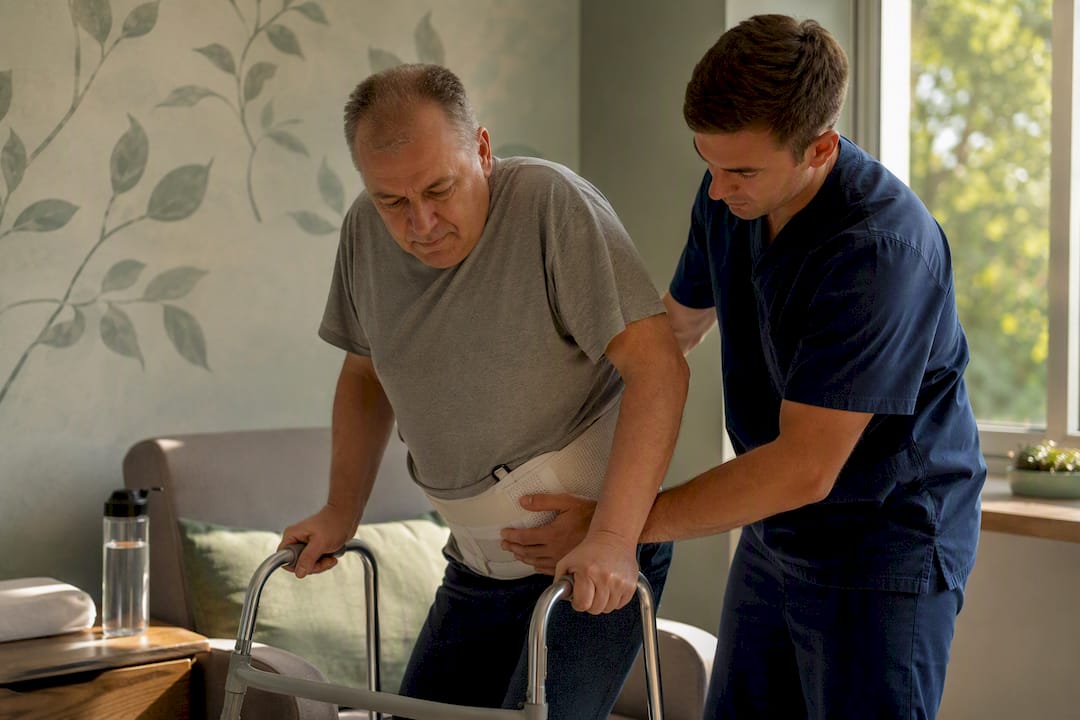
Physical therapy begins right after hip replacement, often within 24 hours, and follows a phase-by-phase progression that restores safe mobility, strength, and function. Most patients complete supervised hip replacement physical therapy within several weeks to a few months, though your timeline depends on your health, your surgery, and how consistently you do your exercises. Early walking and daily home movement matter more than almost anything else in that first stretch. Persistent high pain, fever, or signs of dislocation always warrant a call to your surgeon or physical therapist before you do anything else.
TL;DR:
Patients should prioritize early walking and movement within the first two weeks to reduce complications and support recovery.
Progression to strength training depends on functional benchmarks such as independent walking and muscle strength, not just time since surgery.
Exercises like ankle pumps, gluteal squeezes, and heel slides are essential initially for circulation, swelling reduction, and muscle activation.
Recovery phases are individualized, with most returning to low-impact activities by three months, while high-impact sports require cautious, case-by-case approval.
Close supervision in outpatient or home-based therapy improves outcomes, especially for those with weaker pre-surgery fitness or limited home support.
Table of Contents
How Does Physical Therapy After Hip Replacement Progress by Phase?
Recovery moves through distinct phases, and your therapist advances you based on what your body can actually do, not just how many days have passed since surgery. This matters because two patients having surgery on the same day can be in different phases three weeks later depending on strength, swelling, and how well they stuck to their home program.
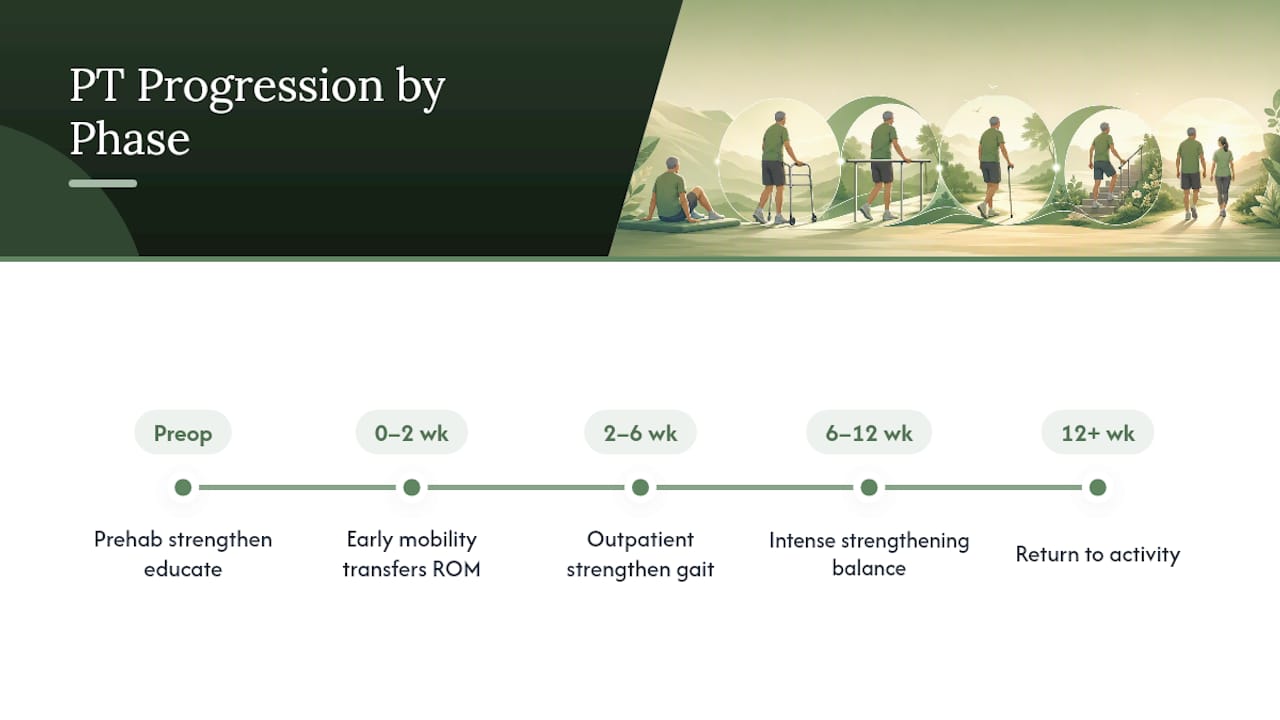
Phase 0 (prehab, before surgery). If your surgeon’s timeline allows it, a few weeks of preoperative strengthening and education can make the early days after surgery noticeably smoother. Preoperative conditioning correlates with a faster, less complicated rehab course, and it gives you a realistic sense of what recovery will actually feel like.
Phase I (day 0 to 2 weeks). This phase happens mostly in the hospital and then at home. Goals include safe transfers in and out of bed, basic walking with a walker or crutches, and restoring gentle range of motion. Rehabilitation starting within 24 hours after surgery is linked to shorter hospital stays and fewer complications when your medical status allows it, which is why most hospital protocols get you standing the same day.
Phase II (2 to 6 weeks). Outpatient or home-based PT typically starts here. Sessions focus on progressing range of motion, adding closed-chain strengthening, normalizing your walking pattern, and weaning off assistive devices as your balance and strength allow.

Phase III (6 to 12 weeks). This is where strengthening intensifies and balance work takes center stage. Clinicians commonly use phase-based frameworks with objective progression criteria rather than a fixed calendar, and you generally need pain-free active motion, adequate strength, and an independent gait pattern before moving forward.
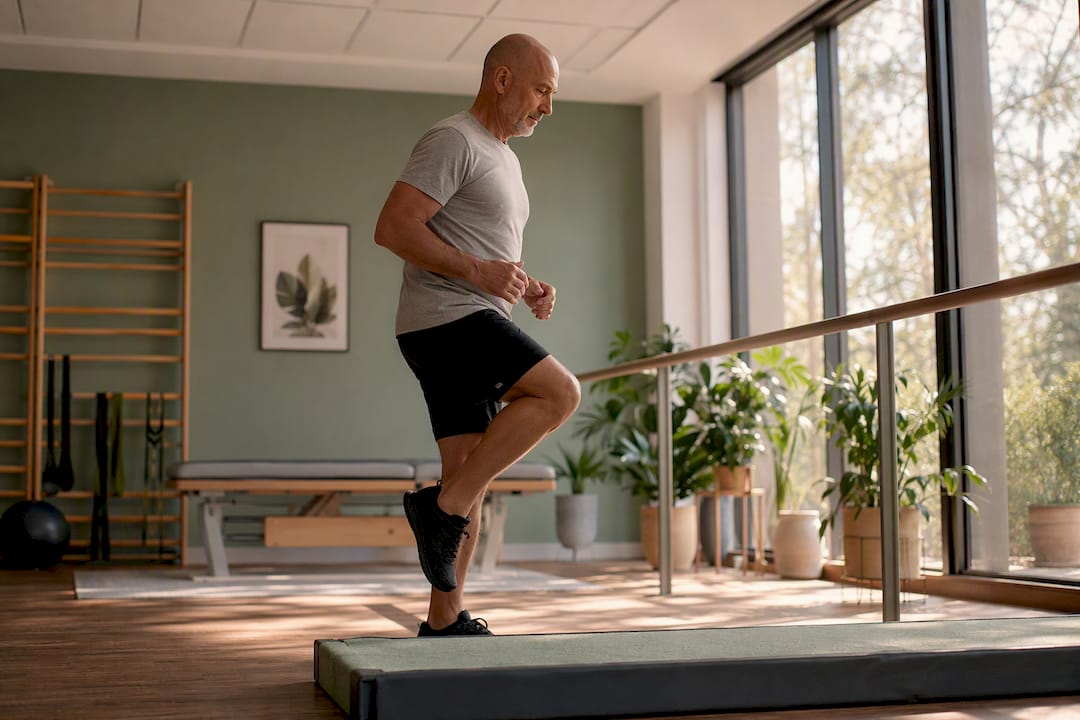
Phase IV (12 weeks and beyond). This is return-to-activity territory. Most people return to low-impact recreation like walking, cycling, or swimming, and higher-impact sports get a far more conservative, individualized green light.
What Exercises Should You Do Right After Surgery?
The exercises in your first two weeks look simple, almost deceptively so, but they do the heavy lifting for circulation, swelling control, and reactivating muscles that surgery temporarily shuts down.
Ankle pumps. Point your toes up and down repeatedly. Do 10 to 20 reps, several times an hour while awake, to reduce blood clot risk and swelling.
Gluteal squeezes. Squeeze your buttock muscles and hold for 5 seconds. Aim for 10 to 15 reps, three to four times daily.
Quad sets. Tighten your thigh muscle, pressing the back of your knee down into the bed. Hold 5 seconds, 10 to 15 reps, several times daily.
Heel slides. Lying down, slide your heel toward your buttock, bending your knee and hip within comfortable limits. Ten reps, two to three times daily.
Short-arc quads. With a rolled towel under your knee, straighten your leg and hold for 5 seconds. Ten reps, two to three sessions daily.
Heel raises. Standing with support, rise onto your toes and lower slowly. Ten reps once you’re cleared to stand comfortably.
Walking starts almost immediately, usually the same day or the day after surgery, with a walker or crutches under supervision; for guidance on safely progressing your mobility, see our safe starter plan to improve mobility after injury. Your therapist will set incremental distance goals. Most people upgrade from a walker to a cane, then to no device, over several weeks as gait quality improves rather than on a fixed schedule.
Pro Tip: Do your exercises in short, frequent bursts rather than one long session. Five minutes every hour beats twenty minutes once a day, and it keeps swelling from building up between movements.
Stop and check in with your therapist if you notice a sudden increase in swelling, drainage from the incision, or pain that spikes well beyond your usual baseline. Those signals mean it’s time to modify, not push through.
When Do You Progress to Strength and Balance Training?
Once you’re walking comfortably and your early exercises feel easy, your program shifts toward the strength and coordination work that lets you return to normal life. This is typically weeks 6 through 12, though functional readiness matters more than the calendar date.
Closed-chain movements, ones where your foot stays planted, become the backbone of this phase:
Mini-squats and sit-to-stands from a chair, progressing depth as tolerated
Step-ups on a low platform to rebuild single-leg control
Controlled forward lunges within a pain-free range
Leg press progressions in a clinic setting to load the hip safely
Single-leg standing work targeting the hip abductors and extensors, the muscles most affected by surgery
Balance training runs alongside strengthening: single-leg stands, foam or unstable-surface tasks, and dynamic stepping drills that mimic real-world movement like curbs and uneven sidewalks.
Clinicians look for specific benchmarks before advancing you further. The Wexner Medical Center’s post-op guideline points to hip abductor strength of at least 4 out of 5 on manual muscle testing, independent community walking, a gait pattern without a limp, and safe stair negotiation as the objective markers that matter more than weeks on a calendar.
From there, most people return to low-impact activities such as cycling, walking, and swimming within about three months. High-impact sports like running or basketball get a much more cautious, case-by-case approach, and many surgeons prefer you avoid them long-term regardless of how good your hip feels.
Where Should You Do Hip Replacement Rehab, and How Often?
Where you do therapy shapes how fast and how comfortably you recover, and the right setting depends on your fitness before surgery, your home support, and any other health conditions you’re managing.
Inpatient rehab or hospital PT happens daily right after surgery, focused on safe mobility and transfers before discharge.
Home health PT brings a therapist to your house, usually two to three times a week for two to three weeks, ideal if getting to a clinic is difficult early on.
Outpatient clinic PT becomes valuable once you can travel comfortably. Sessions typically run 2 to 3 times per week for 30 to 60 minutes, and clinics offer equipment like leg press machines that home settings simply don’t have.
Telerehab offers convenience for exercise coaching and check-ins, though it can’t replace hands-on assessment for gait or joint mobility issues.
Some stable, adherent patients with a solid home program may not need extensive outpatient PT at all, while those with weaker pre-surgery fitness, limited home support, or additional health conditions generally benefit from closer supervision.
What Precautions and Warning Signs Should You Watch For?
Your surgeon will give you specific movement restrictions based on your surgical approach, and following them matters as much as doing your exercises correctly.
Three precautions apply broadly across most hip replacement recoveries:
Avoid deep bending at the hip or twisting your torso while your foot is planted.
Don’t pivot on your operated leg. Turn your whole body instead of rotating at the hip.
Skip heavy lifting or sustained straining until your surgeon clears you.
Watch for red flags that need urgent attention: fever, new drainage or odor from the incision, pain that stays at 6 out of 10 or higher despite medication, numbness, inability to move the limb, or a sudden change in leg length. Early rehab initiation has been shown to reduce length of stay and improve some pain outcomes, but that benefit depends on catching complications quickly rather than pushing through them. If you suspect a dislocation, avoid weight-bearing, keep the leg still, and call your surgeon immediately rather than your physical therapist.
Contemporary Rehab Services’ Approach to Hip Replacement Recovery
Contemporaryrehabservices builds hip replacement plans around the same phase-based structure clinicians rely on nationally, adapting exercises and progression criteria to each patient’s home setup and prior activity level. The clinic accepts Medicare, Aetna, Cigna, Emblem, and United Healthcare, and tracks progress through functional milestones like gait quality, strength testing, and stair performance rather than arbitrary timeframes. Therapists coordinate directly with surgical teams to keep your recovery aligned with your surgeon’s precautions from day one.
— CRS Wellness
Ready to Start Your Hip Replacement Recovery Plan?
Getting hip replacement physical therapy right from the first week sets the tone for everything that follows, and doing it with a clinician who tracks your actual milestones beats guessing your way through generic exercise sheets. Contemporaryrehabservices offers both in-person and virtual sessions for hip replacement recovery, with therapists who build your program around your specific surgery, home setup, and insurance coverage, including Medicare, Aetna, Cigna, Emblem, and United Healthcare.
Every plan starts with an individualized evaluation, since no two hips recover on the same schedule. If you’re near Albertson, our Albertson office can get you scheduled quickly, and patients throughout the area, including Williston Park and Searingtown, have local access to the same phase-based care. For readers who want a broader look at what a structured recovery pathway looks like before booking, our phase-by-phase knee replacement guide walks through a comparable framework, and our pre-surgery PT guide is worth reading if your surgery date is still ahead of you. Visit our services page to see the full scope of what we offer and to start scheduling your first evaluation.
This article is general information, not a substitute for advice from a qualified doctor. Consult a qualified healthcare professional about your own circumstances before acting on anything here.
Sources
Recommended
Comments