
Explaining PT Terminology: A Patient's 2026 Guide

Physical therapy terminology is the specialized language of abbreviations, acronyms, and clinical shorthand that physical therapists use to document assessments, communicate with care teams, and describe treatment plans. Explaining PT terminology clearly is the first step toward helping you become an active participant in your own recovery. When you walk into a clinic in Albertson, NY, or anywhere in Nassau County, your therapist may reference terms like ROM, PROM, AFO, or OCS without pausing to define them. That gap between clinical language and patient understanding is real, and it matters. This guide breaks down the most common physical therapy terms, explains why they exist, and gives you practical tools to decode them with confidence.
What are the common categories of physical therapy terms?
Physical therapy vocabulary falls into five main categories: movement measurements, therapeutic modalities, assistive devices, clinical roles, and board-certified specialties. Recognizing which category a term belongs to helps you understand its purpose before you even look it up.
Range of Motion (ROM) and Passive Range of Motion (PROM) are two of the most frequently seen movement terms in treatment notes and exercise instructions. ROM measures how far a joint moves through its full arc. PROM specifically refers to movement performed by the therapist rather than by you. Knowing the difference tells you whether an exercise is active or assisted, which directly affects how you perform it at home.

Therapeutic modality terms describe treatment tools your therapist applies. TENS stands for Transcutaneous Electrical Nerve Stimulation, a device that sends mild electrical pulses to reduce pain. You may also see terms like US (ultrasound therapy) or IFC (interferential current) in your treatment notes. These are not diagnostic imaging tools. They are hands-on treatment techniques.
Assistive device abbreviations like AFO appear frequently in care discussions and documentation. AFO stands for Ankle Foot Orthosis, a brace that supports the lower leg and foot. Understanding what AFO means helps you connect the device your therapist recommends to the specific goal it serves in your recovery.
The table below groups representative abbreviations by category for quick reference.
Category | Abbreviation | Full Term | Plain-Language Meaning |
Movement | ROM | Range of Motion | How far a joint can move |
Movement | PROM | Passive Range of Motion | Joint moved by the therapist |
Modality | TENS | Transcutaneous Electrical Nerve Stimulation | Electrical pain relief device |
Assistive Device | AFO | Ankle Foot Orthosis | Lower leg and foot brace |
Clinical Role | DPT | Doctor of Physical Therapy | Highest PT degree |
Clinical Role | PTA | Physical Therapy Assistant | Licensed therapy assistant |
Pro Tip: When you see letters after your therapist’s name, those are credentials, not abbreviations for treatments. DPT, MPT, and PTA indicate licensure and education level, not the type of care you will receive.
How do PT specialties shape the terms you encounter?
Board-certified specialties in physical therapy carry their own set of acronyms, and you may see them on care plans, referral letters, or clinic websites. The American Board of Physical Therapy Specialties (ABPTS) recognizes 10 board-certified specialties as of 2026, including orthopedic (OCS), neurological (NCS), and sports (SCS). Each specialty signals a therapist’s focused area of clinical expertise.
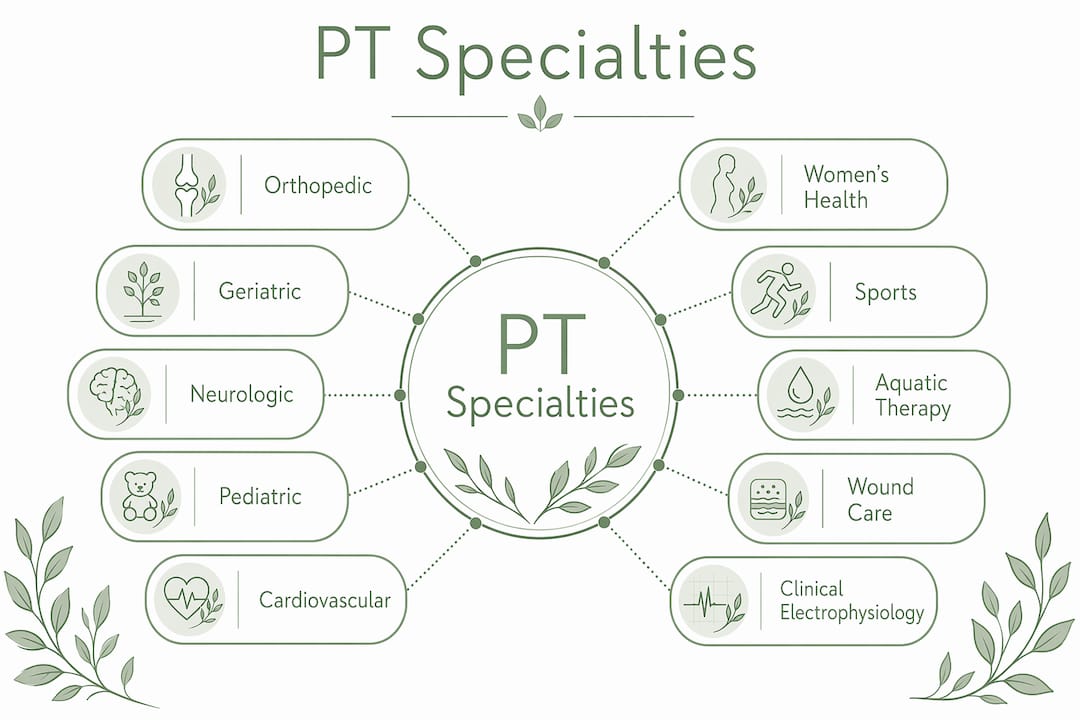
Board certification requires thousands of hours of documented patient care and successful completion of a rigorous exam. That means a therapist with OCS after their name has not just studied orthopedics. They have proven clinical mastery in that area. For you as a patient, these acronyms are a reliable signal that your provider has pursued advanced training beyond their base license.
The table below summarizes all 10 ABPTS specialties for quick reference.
Specialty | Abbreviation | Focus Area | Typical Clinical Setting |
Orthopedic | OCS | Muscles, bones, joints | Outpatient orthopedic clinic |
Neurological | NCS | Brain, spinal cord, nerves | Hospital, neuro rehab |
Sports | SCS | Athletic injuries, performance | Sports medicine clinic |
Cardiovascular & Pulmonary | CCS | Heart and lung conditions | Hospital, cardiac rehab |
Pediatric | PCS | Children’s development and conditions | Pediatric clinic, school |
Geriatric | GCS | Aging-related conditions | Skilled nursing, home care |
Women’s Health | WCS | Pelvic floor, prenatal, postpartum | Outpatient women’s health |
Electrophysiologic | ECS | Nerve conduction, EMG | Specialty diagnostic clinic |
Oncologic | OncCS | Cancer-related rehabilitation | Hospital, oncology center |
Wound Management | WCC | Wound care and healing | Hospital, wound care clinic |
Specialty acronyms typically appear after a therapist’s full name and credentials. If your care plan lists a referral to a therapist with NCS, you are being directed to someone with specialized neurological training. That context helps you ask better questions and understand why that particular provider was chosen for your case.
Why does understanding PT jargon improve your recovery?
Decoding physical therapy jargon is not just an academic exercise. It directly affects how well you follow your treatment plan and how confidently you communicate with your care team. Therapists use abbreviations primarily to improve efficiency in clinical team communication and documentation. That efficiency is designed for the clinical team, not necessarily for you. Recognizing that distinction removes any frustration you might feel when notes seem written in a foreign language.
Language choices in physical therapy also carry psychological weight. Shifting from the word “surveys” to “Patient-Reported Outcomes” reframes your role from passive record-keeper to active partner in your care. That shift is not cosmetic. It changes how invested you feel in tracking your own progress. When you understand what a term means, you engage with it rather than ignore it.
Understanding PT vocabulary delivers concrete benefits throughout your rehabilitation:
You can follow home exercise instructions accurately when you know what AROM (Active Range of Motion) means versus PROM.
You catch errors or mismatches in your treatment notes when you recognize the terms used.
You ask more specific questions, which leads to more useful answers from your therapist.
You feel less anxious during assessments because the language no longer feels unfamiliar.
You track your own progress more meaningfully when you understand the measurements being recorded.
Pro Tip: If your therapist mentions a term you do not recognize, ask for a plain-language explanation right then. Experts view patient questions as positive engagement, not a sign of ignorance. Your question may also prompt your therapist to communicate more clearly with every patient going forward.
What practical steps help patients decode PT reports?
Navigating physical therapy documentation becomes much easier with a few consistent habits. PT terminology varies by clinic and documentation software, and no universal dictionary covers every abbreviation in use. That variability means the same abbreviation can carry slightly different meanings depending on where you receive care. Confirming meanings directly with your therapist is always the most reliable approach.
The following steps give you a clear path to understanding your PT reports and conversations:
Request a terminology walkthrough at your first visit. Ask your therapist to explain any abbreviations that appear in your initial evaluation. Most therapists at patient-centered clinics welcome this conversation. It sets a tone of open communication from day one.
Keep a personal glossary. Write down every new term you encounter, along with its plain-language meaning. A small notebook or a notes app on your phone works well. Review it before each session so the terms become familiar over time.
Read your treatment notes after each visit. Many clinics now provide digital access to session notes through patient portals. Reading them while the session is fresh helps you connect the clinical language to what you actually experienced.
Cross-reference with trusted sources. Resources like Verywell Health’s PT abbreviations guide and Practice Promotions offer reliable plain-language explanations for the most common terms. Use them as a starting reference, then confirm specifics with your therapist.
Ask about any term that affects your home program. If your home exercise sheet includes an abbreviation you do not understand, clarify it before you leave the clinic. Performing an exercise incorrectly because of a misunderstood term can slow your recovery or cause injury.
Understanding your PT patient education materials is just as important as showing up for sessions. The two reinforce each other. Patients who understand their documentation tend to follow through on home programs more consistently, which accelerates recovery timelines.
One more practical note: if you are navigating insurance coverage alongside your therapy, understanding billing terms matters too. Medicare coverage for physical therapy includes specific documentation requirements that your therapist’s notes must satisfy. Knowing what terms like “medically necessary” or “functional limitation” mean in that context helps you advocate for continued coverage when needed.
Key takeaways
Understanding physical therapy terminology is the single most effective way to participate actively in your treatment and communicate clearly with your care team.
Point | Details |
PT terms fall into five categories | Movement, modalities, assistive devices, clinical roles, and specialties each have distinct abbreviations. |
Specialty acronyms signal expertise | ABPTS certifications like OCS and NCS require thousands of clinical hours and rigorous exams. |
Language shapes patient engagement | Terminology like “Patient-Reported Outcomes” actively involves you in tracking your own progress. |
No universal PT dictionary exists | Abbreviations vary by clinic and software, so always confirm meanings directly with your therapist. |
A personal glossary accelerates learning | Writing down and reviewing terms before each session builds familiarity and reduces confusion over time. |
What i’ve learned from watching patients navigate PT jargon
I have watched patients sit through evaluations nodding along to terms they do not understand, then go home and perform their exercises incorrectly. The problem is almost never a lack of intelligence. It is a communication gap that neither side addresses directly.
The honest truth is that clinical shorthand is designed for efficiency among professionals. It was never designed with the patient as the primary reader. When a therapist writes “AROM WFL bilaterally” in your notes, they are communicating quickly with colleagues. You are reading a message that was not originally written for you. That is not a flaw in the system. It is just a reality worth naming.
What I advocate for, both as a professional and as someone who has seen the difference it makes, is a simple habit: therapists should define every abbreviation the first time they use it with a new patient, and patients should feel completely confident asking for clarification at any point. Neither of those things requires extra time. They require a shift in expectation.
The clinics that get this right, including the team at Contemporaryrehabservices, treat terminology explanation as part of the treatment itself. When a patient understands what they are doing and why, they do it better. That is not a soft benefit. It shows up in recovery outcomes. Clearer communication is not a courtesy. It is a clinical tool.
— Tj
How Contemporaryrehabservices makes PT language accessible
Contemporaryrehabservices, a boutique physical therapy clinic serving Albertson, Nassau County, and Queens, NY, builds patient education into every stage of care. The therapists there explain terminology as part of each session, not as an afterthought.
Whether you are recovering from an orthopedic injury, managing a neurological condition, or working through post-surgical rehabilitation, the team at Contemporaryrehabservices walks you through your treatment plan in plain language. They accept Medicare, Aetna, Cigna, Emblem, and United Healthcare plans, making access straightforward. If you are in Nassau County and want care that prioritizes your understanding as much as your recovery, visit the Searingtown physical therapy location or explore the full range of therapy services offered to find the right fit for your needs.
FAQ
What does PT stand for in physical therapy?
PT stands for Physical Therapist, the licensed professional who evaluates and treats movement disorders. It also refers to physical therapy as a discipline, so context determines which meaning applies.
What is the difference between PT and PTA?
A PT (Physical Therapist) holds a doctoral or master’s degree and leads the evaluation and treatment plan. A PTA (Physical Therapy Assistant) is a licensed professional who carries out treatment under the PT’s supervision.
Why do physical therapy notes use so many abbreviations?
Therapists use abbreviations to improve efficiency in clinical documentation and team communication. The shorthand keeps notes concise and standardized across multiple providers involved in your care.
What should i do if i don’t understand a term in my PT notes?
Ask your therapist directly. PT terminology is not universal and varies by clinic, so your therapist is the most accurate source for what a specific abbreviation means in your treatment context.
What does OCS mean after a physical therapist’s name?
OCS stands for Orthopedic Certified Specialist, a credential awarded by the ABPTS. It indicates the therapist has completed extensive clinical hours and passed a specialty exam in orthopedic physical therapy.
Recommended
Comments