
3 Month Phase Based Meniscus Tear Therapy, Clinic Tested

For most people with a torn meniscus, a structured course of physical therapy is the recommended first-line treatment, and it often produces outcomes similar to surgery when applied consistently over a full trial of care. Expect a trial of roughly three months, built around pain control, restoring range of motion, and rebuilding strength in the quads and hips. True mechanical locking or inability to extend the knee is the exception that warrants a faster surgical opinion.
TL;DR:
A minimum three-month trial of physical therapy is recommended before considering surgery for most meniscus tears, with outcomes comparable to surgery at 24 months.
Exercises progress from pain control and swelling reduction to strength building and task-specific drills over a recovery period that can extend beyond six months.
Surgery is advised only in cases of true locking, persistent pain after three months of therapy, or specific tear patterns like bucket-handle or root tears.
Physical therapy typically involves 1-3 sessions weekly, with a focus on controlled progression based on knee response, not fixed timelines.
Recovery usually spans three phases: managing swelling and pain, rebuilding strength, and returning to activity, with some patients opting for surgery if progress stalls.
Table of Contents
Why Meniscus Tear Therapy Is the Starting Point, Not the Backup Plan
Orthopedic guidelines increasingly treat physical therapy as the default first move for a torn meniscus, not the thing you try after surgery disappoints you. The ESSKA-AOSSM-AASPT consensus guideline recommends a minimum three-month trial of structured nonoperative care for degenerative meniscus tears, and for many acute tears as well. That’s not a stalling tactic. It reflects what the trial data actually shows.
Several large randomized trials and systematic reviews comparing physical therapy with arthroscopic partial meniscectomy found no clinically meaningful difference in patient-reported function at 24 months between the two groups. The five-year ESCAPE trial follow-up reinforced the same pattern: patients assigned to physical therapy with the option of delayed surgery ended up about as well off as those who had surgery right away.
The evidence has real limits, though. Outcomes vary by tear type, and no MRI finding or clinical rule reliably predicts who will fail conservative care and need surgery later. That’s why decisions stay individualized rather than formulaic.
Guideline consensus favors a nonoperative trial for degenerative tears and many acute tears
RCTs report comparable 24-month outcomes for physical therapy versus partial meniscectomy in many patients
Tear pattern, age, activity demands, and mechanical symptoms all shape the individual decision
A trial of physical therapy typically runs for a duration recommended by guidelines before surgery enters the conversation for most degenerative and many acute meniscus tears, according to current consensus guidelines.
What Exercises Will Your Physical Therapist Actually Use?
Meniscus rehabilitation exercises follow a fairly predictable arc: calm the knee down, rebuild strength around it, then retrain it for real-world movement. Here’s how that typically unfolds.
Early phase. Quad sets (tightening the thigh muscle with the leg straight), heel slides to nudge back bent-knee range of motion, and straight leg raises to wake up the quadriceps without loading the joint. The goal here is simple: calm the swelling, protect the tear, and stop the muscle from shutting down.
Mid phase. Mini squats, hamstring curls, bridging, and clamshells enter the mix once pain and swelling settle. These build strength through the hips and thighs, usually in the 2 to 3 sets of 10 to 15 reps range, progressing as control improves rather than on a fixed calendar.
Late phase. Single-leg step-ups, balance work on unstable surfaces, and lateral control drills prepare the knee for pivoting, cutting, or the demands of a physical job. This is where general strength turns into task-specific resilience.
Heel raises often get added alongside the mid-phase work to round out lower-leg strength, particularly for anyone returning to walking long distances or stairs. A physical therapy for knee pain guide covers several of these movements with more detail on form.
Swelling or sharp pain that doesn’t settle within a day is a signal to back off, not push through. A brace or crutches for a short stretch is common and not a setback.
Pro Tip: A little soreness that fades within 24 to 48 hours usually means the exercise dose was right. Pain that lingers past that window, or new swelling the next morning, means the load was too much for where your knee is today.
How Long Does Meniscus Repair Rehab Actually Take?
Recovery timelines follow the tissue, not the calendar, but most people move through three recognizable phases.
Phase 1 (0 to 2 weeks): Managing swelling, restoring basic range of motion, and getting pain under control.
Phase 2 (2 to roughly 8 to 12 weeks): Building strength and neuromuscular control, with measurable goals like symmetrical squat depth or step-up height.
Phase 3 (3 months and beyond): Return to sport or physically demanding work, guided by criterion-based testing rather than a fixed date.
Most patients notice meaningful gains in 6 to 12 weeks of consistent rehab, with function often continuing to improve well beyond that window. A small number will still choose surgery later if progress stalls.
When Should You See a Surgeon Instead of Continuing Therapy?
Most meniscus tears respond to conservative care, but a few signs mean you need an orthopedic evaluation rather than another few weeks of exercises.
A knee that’s genuinely locked, meaning you cannot fully straighten it, not just stiffness or discomfort
A sense of the knee giving way repeatedly, or pain that hasn’t budged after a full three-month PT trial
Bucket-handle or root tear patterns, which surgeons discuss more often as candidates for repair
Imaging showing a displaced fragment blocking normal joint mechanics
A true locked knee is a distinct clinical picture from tightness or swelling, and it typically moves you toward imaging and a surgical opinion faster. When surgery does happen, physical therapy usually still bookends it, both before and after.
What Happens During Your Physical Therapy Visits?
Your first visit centers on a detailed evaluation: history of the injury, range of motion, strength testing, and how you walk. From there, your therapist builds goals specific to your knee and your life, not a generic template.
Sessions typically run one to three times per week, with the rest of the work happening through your home program
Progression is based on how your knee responds, not how many weeks have passed
Therapists often track outcomes with tools like the IKDC score or simple performance tests, such as step-up height or single-leg balance time, to decide when you’re ready to advance
Insurance coverage for meniscus injury rehab is common. Insurance coverage for meniscus injury rehab is common, with many providers accepting major insurance plans and direct payment options. A step-by-step rehab guide walks through what a typical home program looks like between visits.
How a Local Clinic Applies Phase-Based Meniscus Rehab
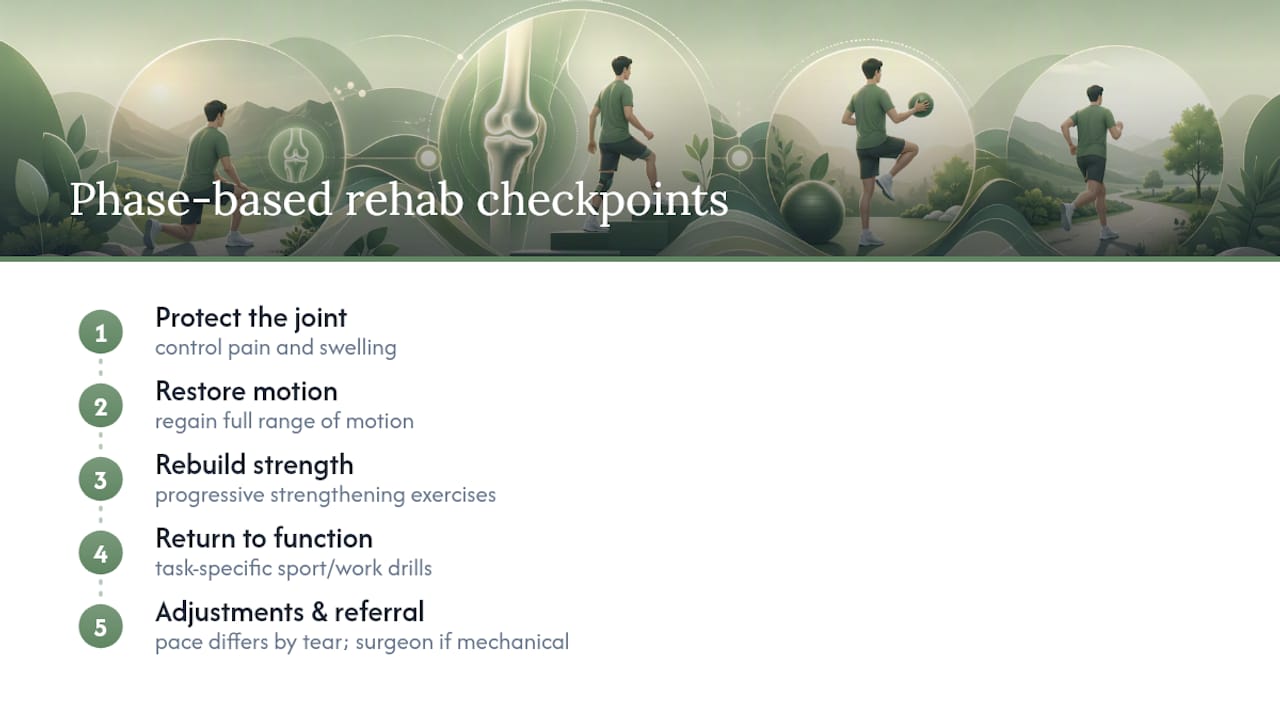
Meniscus injury treatment typically follows four checkpoints: protect the joint, restore motion, rebuild strength, and return to function, each with measurable goals before moving forward. Degenerative tears in older patients get a different pace and emphasis than traumatic tears in younger, more active patients, and coordination with an orthopedic surgeon happens whenever mechanical symptoms suggest more than rehab alone can fix. The clinic’s knee osteoarthritis physical therapy resource outlines a similar phase structure for related knee conditions.
Setbacks Happen. Here’s How to Handle Them Without Losing Progress
Your knee will not improve in a straight line, and that’s normal, not a warning sign. A flare after a longer walk or a missed rest day usually means the tissue got more than it could handle that day, not that the tear is worsening.
A simple flare plan: back off the aggravating activity for 48 to 72 hours, use ice for comfort, then return to your modified program. Contact your therapist if you notice true locking, giving way, or swelling that won’t quit. A step-by-step injury recovery guide covers pacing strategies that apply directly here, and outside resources like this physical therapy exercise guide offer additional pain-relief techniques worth trying between visits.

Ready for Supervised Meniscus Tear Therapy Near You?
Some local clinics provide hands-on, phase-based meniscus rehab that can avoid wait times or rotating providers common at larger orthopedic groups, with both in-person and virtual sessions available depending on recovery needs.

Your first visit includes a full evaluation of your knee’s range of motion, strength, and gait, followed by a rehab plan built around your specific tear and activity goals, not a generic protocol pulled off a shelf. The clinic accepts Medicare, Aetna, Cigna, Emblem, and United Healthcare, along with direct payment for patients who prefer it. If you’re in Nassau County or Queens, the Albertson location is a straightforward place to start. Book an initial evaluation there to get a personalized timeline instead of guessing at one from an article.
Where This Information Comes From
ESSKA-AOSSM-AASPT consensus guideline on meniscus rehabilitation
Five-year ESCAPE trial follow-up on PT versus meniscectomy
Systematic reviews comparing PT and arthroscopic partial meniscectomy
This article is general information, not a substitute for advice from a qualified doctor. Consult a qualified healthcare professional about your own circumstances before acting on anything here.
Sources
Recommended
Comments